Germany Presses Kyiv to Include Its Defense Industry in Ukraine Procurement
Foreign Minister Johann Wadephul links Berlin’s support for Ukraine to a stronger role for German suppliers in defense purchases.
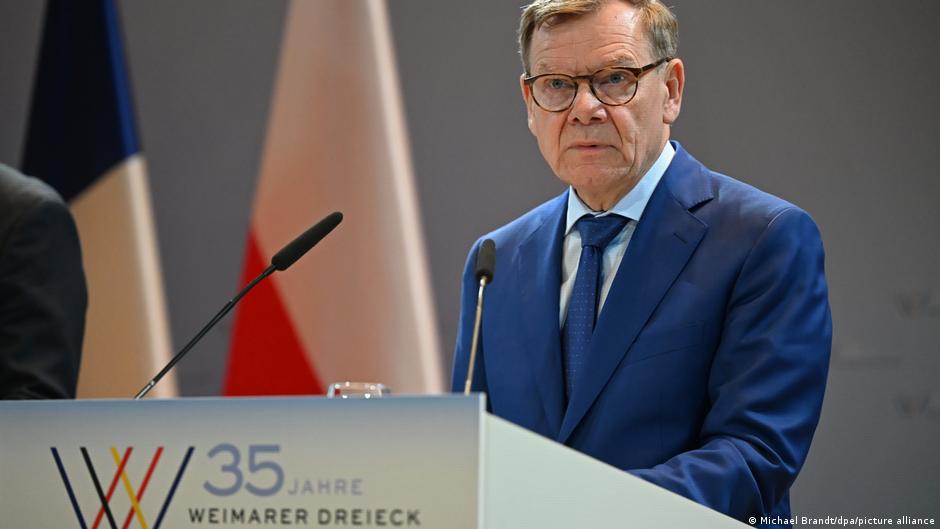
German Foreign Minister Johann Wadephul has urged Kyiv to pay closer attention to Germany’s interests, saying that Berlin’s defense industry should benefit from the country’s extensive financial and military support for Ukraine. His remarks point to a sharper economic and industrial-policy dimension in Europe’s Ukraine strategy, as governments seek to reconcile security commitments with domestic fiscal and manufacturing priorities.
In an interview published by Bild on Tuesday, September 8, Wadephul criticized Ukrainian President Volodymyr Zelensky and said Germany’s role as a leading backer of Kyiv should be reflected in procurement decisions. The comments come as Berlin continues to expand assistance to Ukraine, including a recently announced additional package worth 60 million euros and a further 10 million euros for a NATO fund supporting energy supplies, medical equipment and systems to protect against drones.
“At the moment, we are Ukraine’s strongest supporter in terms of financial and military support,” Wadephul said, adding that “naturally, the German defense industry must benefit from this.”
For senior economic decision-makers, the significance of the statement lies less in the immediate size of the aid package than in the policy signal. Germany is indicating that support for Ukraine is increasingly being framed not only as a foreign-policy and security obligation, but also as an industrial and taxpayer proposition. That framing may become more common across Europe as defense spending rises, procurement cycles lengthen and governments face pressure to show that overseas commitments reinforce domestic economic capacity.
Industrial Policy Enters the Ukraine Support Debate
Wadephul said he raised the issue directly with Zelensky during a recent visit to Kyiv. Recounting his message to the Ukrainian president, he said Germany stands with Ukraine and supports it, but that he must also explain this position to German taxpayers. At a minimum, he said, German defense companies should participate in all procurement processes.
The wording is important. Wadephul did not say Germany would end support, nor did he announce a formal procurement condition. But by tying taxpayer accountability to the participation of German industry, he highlighted a growing tension in European policy: military aid is no longer viewed solely as a transfer of resources to Ukraine, but also as a mechanism that can sustain national defense production, employment, research and supply-chain resilience.
That shift has broader macroeconomic implications. Defense procurement is capital-intensive, politically sensitive and increasingly central to Europe’s medium-term investment outlook. If major donor states seek a guaranteed or expanded role for their own companies in Ukraine-related purchases, the structure of aid may evolve toward more nationally anchored procurement models. Such an approach could support domestic manufacturers, but it may also complicate coordination among allies if national industrial priorities begin to compete with speed, interoperability or price.
Germany’s position is particularly relevant because of the scale of its backing for Ukraine. Wadephul described Berlin as Kyiv’s strongest supporter in financial and military terms. Whether or not procurement rules formally change, the statement sets expectations: German voters and industry will be told that strategic support should carry domestic economic returns, and Ukrainian officials may face more explicit pressure to account for donor-country industrial interests.
Fiscal Pressures and Defense Supply Chains
The remarks also reflect the fiscal politics behind Europe’s security posture. Governments supporting Ukraine must finance military assistance, humanitarian aid, energy-related measures and domestic defense modernization at the same time. In that context, Wadephul’s appeal to German taxpayers is a reminder that sustained support depends on political legitimacy at home. For a large economy such as Germany, linking aid to industrial participation can help present defense spending as both security policy and economic policy.
On August 22, Wadephul visited Kyiv and held a joint press conference with Ukrainian Foreign Minister Andrii Sybiha. During that visit, he announced additional aid of 60 million euros for Ukraine. Germany will also transfer another 10 million euros to a NATO fund whose resources are used, among other purposes, for supplies of energy carriers, medical equipment and anti-drone protection systems.
These categories of support show the breadth of Ukraine’s wartime economic needs. Energy supplies are tied directly to macroeconomic stability, medical equipment to the resilience of public services, and anti-drone systems to the protection of infrastructure and personnel. As such spending becomes more institutionalized, procurement decisions will increasingly shape not only battlefield capacity but also industrial demand across Europe.
Wadephul also announced further talks with partners from various countries on supplying Ukraine with additional air defense systems. Air defense remains one of the most consequential areas of support because it affects the security of cities, energy facilities and industrial assets. From an economic perspective, improved air defense can reduce damage to critical infrastructure and help stabilize production, logistics and public services. At the same time, supplying such systems requires coordination among governments and producers at a moment when defense-sector capacity is under growing strain.
The German foreign minister’s message therefore fits into a wider policy recalibration. Europe is moving from emergency assistance toward a longer-term model in which Ukraine support, defense rearmament and industrial strategy are linked. That model may create durable demand for defense firms, but it also introduces questions about allocation, burden-sharing and the balance between national economic returns and Ukraine’s immediate operational needs.
For Ukraine, the diplomatic challenge is to preserve broad allied backing while navigating the expectations of individual donors. For Germany, the challenge is to maintain support for Kyiv while demonstrating that public funds also strengthen domestic strategic industries. Wadephul’s comments make clear that, in Berlin’s view, those two objectives should increasingly be pursued together.