Russia Extends Kyiv Strikes, Raising Economic Pressure on Ukraine
The renewed missile and drone attacks on Kyiv underscore the widening economic costs of sustained urban warfare and infrastructure risk.
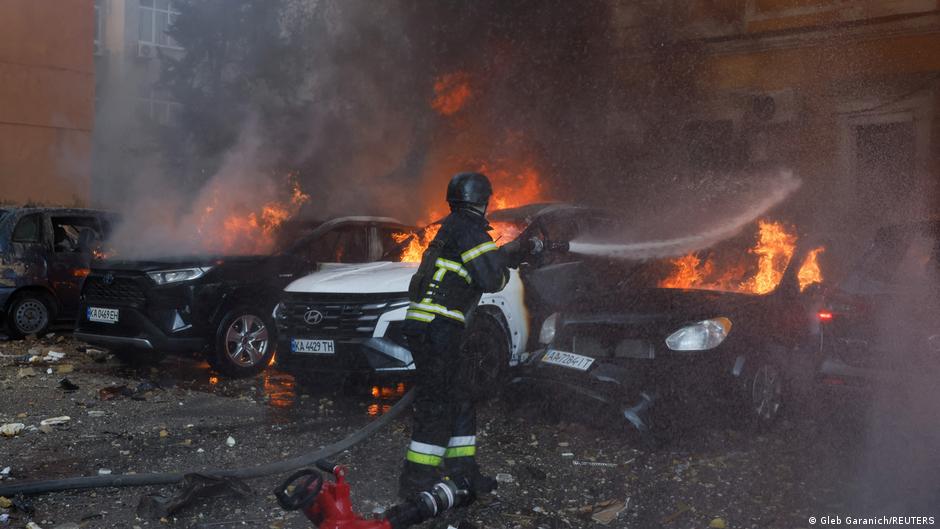
Russian forces again attacked Kyiv overnight into Tuesday, September 29, extending a sequence of strikes that had already hit the Ukrainian capital during the previous day. The latest attacks involved ballistic missile debris and unmanned aerial vehicles, according to city officials, and followed daytime strikes in central Kyiv that killed two people and injured 26.
For senior policymakers and business leaders, the renewed assault on the capital is not only a military development. It is also a reminder that Ukraine’s wartime economy remains exposed to recurring shocks in its administrative, scientific, medical and residential infrastructure. Each additional attack complicates planning for reconstruction, public finance, insurance, investment and the delivery of essential services.
Kyiv Mayor Vitali Klitschko said that debris from a ballistic missile fell in the courtyard of a residential building in the Solomianskyi district. He said there was no fire at that location. In the Pecherskyi district, however, a fire broke out in a three-story non-residential building. Klitschko later clarified that in the Solomianskyi district, a fire also occurred in one of the buildings of an educational institution after the strike.
“In the Solomianskyi district, missile debris fell in the courtyard of a building. There is no fire. In the Pecherskyi district, a fire broke out in a three-story non-residential building,” Klitschko wrote on Telegram.
No information was reported about deaths or injuries resulting specifically from the overnight attacks. Kyiv’s city military administration also reported that a drone had fallen onto a roadway. Officials additionally reported a fire after debris fell on the roof of a five-story building in the Holosiivskyi district.
Urban Strikes and the Economic Cost of Persistent Risk
The attacks came after a day of strikes in central Kyiv beginning on September 28. Klitschko said that from the start of that day, two people had been killed and another 26 injured in the city. Eight of the wounded required hospitalization, and one was in serious condition.
Both fatalities were caused by a drone strike on the building of Ukraine’s National Academy of Sciences. The attack triggered a major fire, left people trapped inside and forced many to escape through windows. Another Russian strike hit the building of the Dobrobut medical center.
The choice of targets and the geography of the damage matter for Ukraine’s longer-term economic trajectory. Kyiv is not only the political center of the country; it is also a hub for research, education, medical services and administrative decision-making. Damage to scientific institutions such as the National Academy of Sciences carries consequences beyond immediate repair costs. It can disrupt research capacity, destroy equipment, slow institutional work and contribute to the broader loss of human capital that often accompanies prolonged conflict.
Damage to medical facilities has a similarly compounding effect. Even when a strike does not shut down a health provider entirely, it can divert resources from normal care, increase demand on other facilities and add to the fiscal burden on municipal and national authorities. The attack on a medical center building therefore fits into a broader pattern in which wartime destruction strains both public budgets and private service networks.
Residential areas and roadways also form part of the economic picture. Missile debris falling near homes, drones landing on roads and fires on apartment-building roofs raise the perceived risk of daily activity in the capital. That risk influences household behavior, commercial operating decisions and labor mobility. Businesses must account for interruptions, employee safety, physical damage and contingency costs. Households face the uncertainty of repeated alarms, property damage and disrupted local services.
Policy Implications for Ukraine and Its Partners
The continuation of strikes on Kyiv highlights the durability of security risk that foreign governments, lenders and investors must incorporate into their assumptions about Ukraine. Reconstruction cannot be treated as a linear postwar process if critical urban assets remain vulnerable during the conflict. Instead, Ukraine and its partners face the challenge of financing repair, emergency response and resilience while attacks continue.
That has several macroeconomic implications. First, recurrent attacks increase pressure on public spending. Municipal authorities must respond to fires, debris, emergency repairs and support for affected residents, while national authorities must maintain defense and civilian services at the same time. Second, destruction of educational, scientific and medical assets can weaken productive capacity over time, particularly if skilled workers are injured, displaced or forced to operate under unstable conditions. Third, the recurring threat to urban infrastructure may raise the cost of private capital and insurance, even in sectors not directly hit by strikes.
For European and international policymakers, the attacks reinforce the link between air defense, fiscal sustainability and economic stabilization. Protection of cities is not only a security question; it shapes Ukraine’s ability to maintain institutional continuity and limit the long-term scarring of its economy. The more often critical urban infrastructure is hit, the more reconstruction needs shift from discrete capital projects to an ongoing requirement for resilience funding.
The overnight strikes also illustrate the widening economic consequences of drone and missile warfare. Low or recurring disruption can impose heavy cumulative costs even without large casualty figures from every incident. Fires, debris, road closures, emergency deployments and damaged public or private buildings can repeatedly interrupt normal urban functioning. Over time, those disruptions feed into productivity losses, higher operating costs and deeper dependence on external assistance.
For senior decision-makers assessing Ukraine’s outlook, the latest attacks on Kyiv point to a central policy reality: the economic battlefield includes universities, medical facilities, apartment blocks, roads and administrative districts. The immediate human toll remains paramount, but the broader economic cost is measured in degraded institutions, strained budgets and a more uncertain investment environment. As long as strikes on the capital continue, Ukraine’s macroeconomic resilience will depend not only on financial aid and reform, but also on the capacity to protect and restore the systems that allow the economy to function under fire.