Germany Deploys Eurofighters to Latvia as NATO Reinforces Baltic Airspace
The short-term mission underscores how Baltic security risks are becoming a recurring factor in Europe’s defense planning and fiscal priorities.
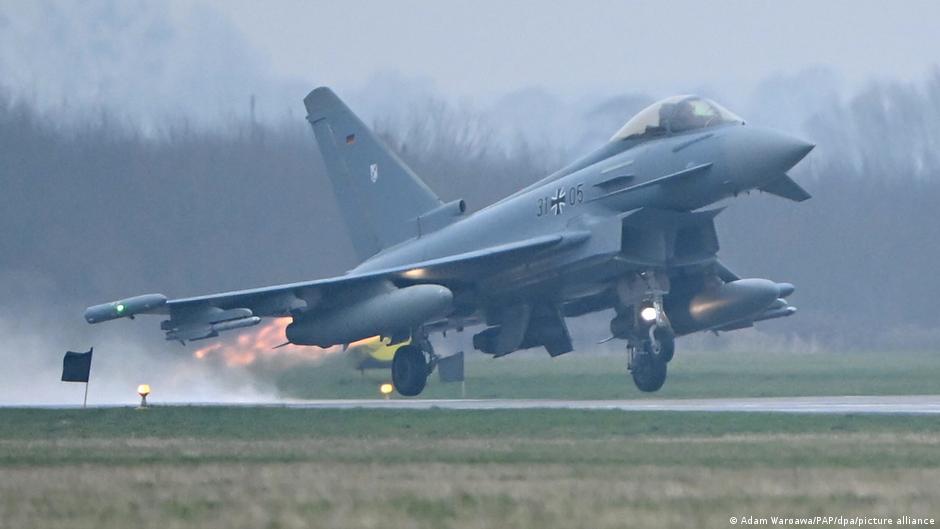
Germany has deployed four Eurofighter jets to Latvia for a little over a week to help secure the country’s airspace during parliamentary elections scheduled for October 3, a move that highlights the growing intersection between European security policy, NATO deterrence and the region’s long-term economic outlook.
The aircraft, drawn from the Bundeswehr’s 74th Tactical Air Wing at Neuburg an der Donau air base, were transferred to the Lielvarde military airfield in central Latvia. Latvia’s defense ministry announced the deployment on Thursday, September 24. During their stay, the Eurofighters will support NATO’s integrated air and missile defense system.
Latvia requested support from NATO allies against the backdrop of repeated violations of the airspace of Baltic states, the dpa news agency noted. The timing, around a national parliamentary vote, gives the deployment a specific political-security purpose, but its broader implications extend beyond one election cycle.
Latvian Prime Minister Andris Kulbergs called Germany’s move “a concrete sign of NATO solidarity” and thanked Berlin for its “readiness to help and close cooperation.”
Kulbergs said on X that the deployment reflected a shared commitment to protecting Latvia’s airspace and the security of the Latvian population. For policymakers and senior business decision-makers, the episode is another marker of how Europe’s northeastern flank is moving from a periodic security concern to a sustained strategic priority.
Security Costs Become Part of the Economic Baseline
NATO has been responsible for air policing over the alliance’s northeastern flank since Estonia, Latvia and Lithuania joined in 2004. That long-running mission has taken on heightened importance since Russia launched its full-scale war against Ukraine. Since then, drones have repeatedly entered the airspace of Baltic states. In August, NATO fighter jets shot down a drone that had violated Latvian airspace.
For Baltic governments, the repeated incursions reinforce the case for deeper integration with NATO air and missile defense systems. For the rest of Europe, they point to an increasingly permanent fiscal and industrial-policy challenge: deterrence requires standing capabilities, recurring deployments and defense procurement pipelines that can be sustained over multiple budget cycles.
The German deployment is short-term, but it sits within a pattern of long-duration commitments. From December 2026, Eurofighters are due again to take over NATO airspace surveillance from Estonian territory for an extended period under the NATO Air Policing mission. Until March 2027, five Eurofighter jets, together with flight crews, will be stationed at Amari air base in northwestern Estonia.
That schedule matters economically because it signals that air defense in the Baltic region is no longer being treated as an episodic emergency response. Instead, it is becoming a recurring operating requirement for NATO members. For defense ministries, this increases pressure to align force availability, maintenance capacity and procurement planning. For finance ministries, it adds to the long-term cost of European security at a time when governments are already balancing defense spending with energy transition investments, demographic pressures and sluggish growth.
Macroeconomic Implications for Europe’s Policy Mix
For senior decision-makers, the key issue is not the number of aircraft in this particular deployment, but the policy signal behind it. Four Eurofighters in Latvia for just over a week will not, on their own, change Europe’s macroeconomic trajectory. Yet repeated deployments, reinforced patrols and greater readiness requirements point toward a structural shift in public spending priorities across the continent.
Germany’s role is especially significant. Berlin is one of Europe’s largest economies and a central actor in NATO’s European pillar. Its willingness to provide aircraft for Latvia’s election-period security indicates that European defense support is becoming more operationally visible, not only politically declarative. This could have implications for how European governments frame defense spending in future fiscal debates, particularly if airspace violations remain frequent or if the war in Ukraine continues to shape threat perceptions.
The Baltic states are small economies, but their security environment has outsized importance for the European Union and NATO. Airspace insecurity can influence investor perceptions, infrastructure planning, insurance assumptions and the cost of maintaining resilient supply chains near the alliance’s eastern border. While the source details do not point to any immediate economic disruption, the broader policy context suggests that national security resilience is increasingly inseparable from economic resilience.
The deployment also highlights the importance of multinational burden-sharing. Latvia’s request to NATO allies, and Germany’s response, reflect a model in which smaller frontline states rely on larger allied militaries for capabilities that would be expensive to replicate independently. Economically, this spreads the cost of deterrence across the alliance, but it also requires political consensus among member states to maintain readiness and absorb operational expenses.
For NATO, the integrated air and missile defense system is both a military architecture and a long-term investment framework. Sustaining it requires aircraft, crews, bases, logistics, maintenance, command systems and interoperability. Each of those elements has budgetary and industrial implications. As European governments reassess security assumptions, defense firms and supply chains tied to aviation, sensors, missiles and maintenance services are likely to remain central to policy discussions.
The Latvian election-period deployment is therefore best understood as a small but telling event in a larger economic-security transition. Europe’s strategic environment is pushing governments to treat deterrence as a permanent public good rather than an exceptional expense. That shift may gradually reshape budget priorities, defense industrial planning and the policy trade-offs facing Europe’s largest economies.