German Protests Against Far Right Signal Rising Policy Strain in Europe
Large demonstrations across Germany underscore the political risks facing Europe’s largest economy as the AfD gains electoral ground.
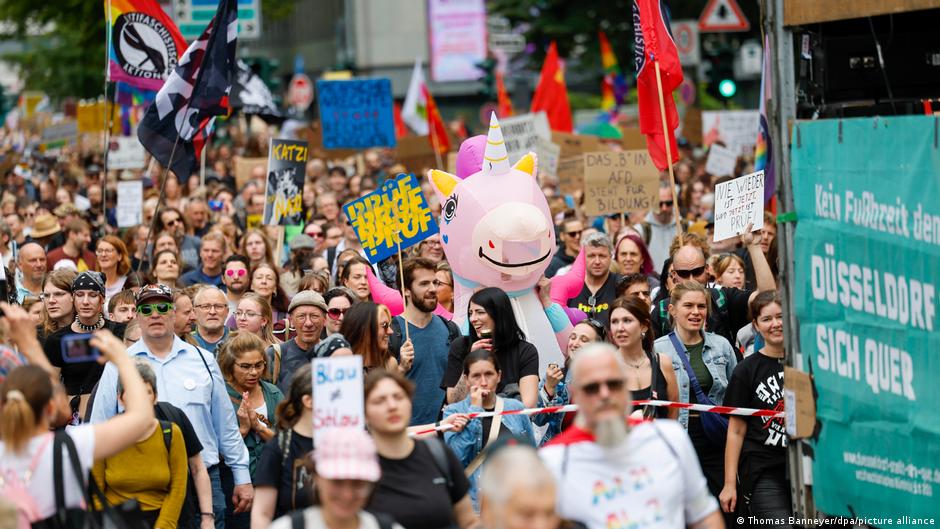
Mass demonstrations against right-wing extremism took place in more than 35 German cities on September 12, drawing tens of thousands of people into the streets one week after the far-right Alternative for Germany, or AfD, won state elections in Saxony-Anhalt. For senior decision-makers, the protests point to a deepening political fault line in Europe’s largest economy, where questions over institutional resilience, party bans and coalition boundaries are increasingly moving from domestic debate into the wider economic risk landscape.
Organizers said 25,000 people attended a demonstration in Hamburg, while around 20,000 joined in Düsseldorf. Local police also confirmed the Düsseldorf figure. In Berlin, police estimated turnout at 18,000. Public broadcaster ARD estimated that 12,000 people took part in Munich, while around 2,000 demonstrated in Mainz.
The protests were organized by more than 100 associations and civic groups. They followed a sharp political shock in Saxony-Anhalt, where the AfD’s victory in state elections has intensified national debate over how German institutions should respond to a party that the domestic intelligence service has scrutinized over right-wing extremism concerns.
Political Risk Broadens Beyond Electoral Cycles
The demonstrations were not limited to Germany’s largest cities. In Magdeburg, the capital of Saxony-Anhalt, about 1,100 people took part. In Saarbrücken, turnout was around 1,500. Several hundred people demonstrated in Erfurt. In Schwerin, capital of Mecklenburg-Western Pomerania, where local elections are due in a week and surveys also show the AfD leading, several dozen people joined protests.
That geographic spread matters. Germany’s political stability has long been treated as one of the anchor assumptions for European economic planning. The latest mobilization suggests that the country’s internal political contest is becoming more structurally consequential, touching on questions of constitutional safeguards, regional governance and the durability of consensus-based policymaking.
For investors and corporate leaders, the immediate economic implications are indirect but material. Germany remains central to European industrial policy, fiscal coordination, energy transition planning and the European Union’s response to global competition. A more fragmented political landscape could make long-term decision-making harder, particularly if state-level results continue to unsettle federal party strategies and coalition discipline.
Several of the demonstrations, including those in Munich, Mainz, Saarbrücken and Magdeburg, were held as part of the Prüf campaign. The campaign calls for thorough scrutiny of parties classified by the Federal Office for the Protection of the Constitution, known as the BfV, as “suspected” of right-wing extremism or as “definitely right-wing extremist.” The German word “Prüf” means “check.” Organizers also present it as an acronym for Prüfung Rettet Übrigens Freiheit, meaning “Checking, incidentally, saves freedom.”
“Checking, incidentally, saves freedom.”
At the demonstrations, participants called for the launch of proceedings to ban the AfD. In May 2025, the BfV classified the party as right-wing extremist at the federal level, although the classification is not currently in effect because of a lawsuit filed by the party.
The demand for a party ban marks an escalation in the debate. Germany’s postwar constitutional order allows for restrictions on parties deemed to threaten the democratic order, but such steps carry high legal and political thresholds. For policymakers, the issue is therefore not only whether the AfD can be constrained through legal means, but whether attempts to do so could further polarize the electorate or reshape voter perceptions of institutional legitimacy.
Firewall Debate Tests Germany’s Governing Model
The protests also highlighted pressure on Germany’s so-called firewall policy toward the AfD, under which mainstream parties refuse cooperation with the party. In Düsseldorf, demonstrators marched under the slogan “Not one step back! Against the AfD and right-wing agitation” in German. In Hamburg, the slogan was “Time to act — freedom must be defended.”
Yet polling suggests the public is divided on both the proposed ban and the firewall strategy. An INSA opinion survey conducted on September 10 and 11 found that 42% of respondents supported the idea of banning the AfD, while 45% opposed it. The same poll showed that 46% of Germans opposed the firewall policy that rules out cooperation with the AfD. Thirty-four percent supported maintaining the barrier, while 20% were undecided.
Those figures expose a strategic dilemma for Germany’s established parties. Maintaining the firewall may preserve a clear institutional line against the far right, but it can complicate coalition arithmetic as the AfD gains support in regional contests. Weakening the firewall could ease short-term governing constraints in some settings, but it would carry significant reputational and policy risks domestically and across the European Union.
The economic consequences are likely to emerge through governance rather than through an immediate market shock. If Germany’s party system becomes more fragmented, policy implementation could slow in areas where businesses and European partners are seeking clarity: industrial competitiveness, labor supply, defense spending, migration policy, energy costs and fiscal priorities. Regional election outcomes may increasingly influence national policy calculations, particularly as mainstream parties assess whether their existing strategies are electorally sustainable.
The protests therefore represent more than a civic response to one election result. They signal that Germany’s democratic institutions are entering a period of heightened stress just as the country faces long-term economic challenges. The tension between legal containment, political exclusion and electoral competition is becoming a central variable in assessing Germany’s policy trajectory.
For Europe, the stakes are broader. Germany’s domestic political direction affects EU coordination on trade, climate policy, enlargement, fiscal rules and support for Ukraine. A country once viewed as a predictable stabilizer now faces a more unsettled internal environment, with public opinion split over how to respond to the far right’s advance.
The demonstrations on September 12 showed that civic resistance to right-wing extremism remains large and organized. They also showed that the policy questions now confronting Germany are unlikely to fade quickly. The result is a more complex macro-political outlook: one in which institutional resilience, voter polarization and coalition viability may shape economic decision-making as much as conventional indicators of output, inflation or public finance.