Yabloko Clears Novgorod Threshold, Preserving a Route Into Russia’s Ballot System
The liberal party’s regional result has implications beyond Novgorod, sustaining its formal access to future State Duma contests without signature collection.
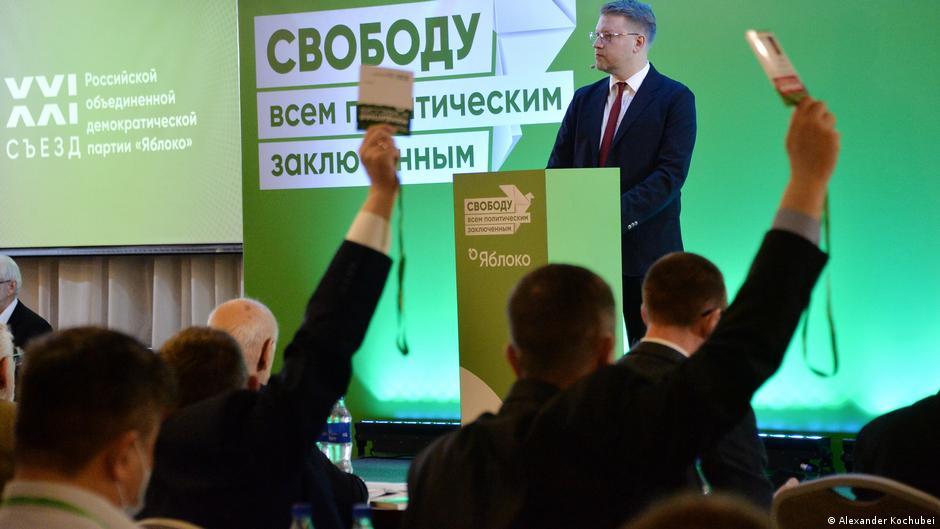
Russia’s liberal Yabloko party is on course to enter the Novgorod regional parliament after receiving 6.2% of the vote with 96.86% of precinct protocols counted, according to Russia’s Central Election Commission. The result clears the 5% threshold required for representation in the Novgorod regional Duma and gives the party a practical institutional benefit: it can continue to participate in future State Duma elections without collecting voter signatures.
The outcome is modest in numerical terms but notable in Russia’s tightly managed political environment. For senior economic and policy observers, the result matters less as a shift in regional governance and more as a signal about how much electoral pluralism remains inside Russia’s formal political system. Yabloko is the only Russian party that has opposed the war in Ukraine, and its ability to retain a parliamentary foothold has implications for political risk analysis, sanctions policy, and long-term assessments of Russia’s domestic institutional trajectory.
The Novgorod contest was for the eighth convocation of the regional Duma, held through the single electoral district. Yabloko’s 6.2% share compares with 3.83% at the same level of election in 2021, suggesting that the party improved its performance despite a campaign environment described by a party source as highly constrained.
United Russia remained the leading force in the Novgorod vote, receiving 38.37% according to the same preliminary data. The Communist Party of the Russian Federation received 14.54%, the Liberal Democratic Party of Russia 12.01%, New People 9.87%, A Just Russia 7.7%, and the Party of Pensioners 5.55%.
A Small Regional Result With National Political Consequences
The central consequence of Yabloko’s apparent success is procedural. Under Russia’s electoral rules, representation in a regional legislature can preserve a party’s ability to run in State Duma elections without undergoing the more burdensome process of collecting signatures. That exemption can be strategically important for smaller parties, particularly those that face administrative pressure or limited access to the political process.
A source in Yabloko, speaking to DW on condition of anonymity, said the preliminary result in Novgorod was a source of relief for the party because of its practical effect.
“In Novgorod, of course, we are very pleased with the preliminary result. For the party, it also has a very practical significance: having a deputy in a regional parliament will allow Yabloko to continue participating in State Duma elections without collecting signatures.”
The source noted that before these elections the party had three factions, in Pskov, St. Petersburg, and Karelia, but that lists there were removed. That makes the Novgorod result more than a local matter. It helps preserve a legal path for Yabloko’s future participation in federal elections, even after setbacks elsewhere.
From a macroeconomic perspective, political access rules are not peripheral. They shape the predictability of policymaking, the credibility of formal institutions, and the range of views that can enter public debate. In economies facing heavy geopolitical pressure, such as Russia’s, the narrowing or survival of channels for legal opposition can influence investor assumptions about institutional durability, elite signaling, and potential future policy adjustment.
Administrative Pressure and Political Risk
The Yabloko source described the Novgorod campaign as taking place under extremely difficult conditions. According to the source, the entire party list on the ballot was marked with a label referring to a “foreign agent” because the list’s leader, party deputy chair Anna Cherepanova, had been recognized as affiliated with a “foreign agent.” The source also said Cherepanova herself was removed from the election because of an administrative case under Article 20.3 of Russia’s Code of Administrative Offenses.
Despite those obstacles, the source argued that neither the labeling nor the removal of the list leader prevented the party from showing a strong result. The combination of legal restrictions, ballot labeling, and candidate exclusion illustrates a broader institutional environment in which formal electoral participation remains possible but increasingly shaped by administrative constraints.
That environment is relevant for economic decision-makers because political risk in Russia is closely tied to the state’s management of institutions. The war in Ukraine, sanctions, capital controls, fiscal pressures, and state-directed industrial priorities have already altered the operating environment for domestic and foreign actors. Electoral restrictions do not directly determine macroeconomic outcomes, but they affect the range of policy feedback mechanisms available to the state and the visibility of dissenting positions on major national questions.
Yabloko’s anti-war position gives the result additional significance. The party’s survival in a regional legislature keeps a formal opposition voice inside the electoral framework, even as its federal prospects have been curtailed. On August 10, Russia’s Supreme Court removed Yabloko’s federal party list from the State Duma election following a lawsuit by Rodina, which accused the party, among other things, of copyright violations and illegal payments for election campaigning. Even so, Yabloko candidates in single-mandate districts are taking part in the vote.
The removal of the party’s federal list was criticized by Jürgen Hardt, the foreign policy spokesman for the CDU/CSU parliamentary group in Germany’s Bundestag. In comments to DW, he said that by excluding Yabloko, Russian President Vladimir Putin had removed the last significant opposition voice from the electoral process.
For global observers, the Novgorod result therefore presents a mixed signal. On one hand, Yabloko’s entry into the regional Duma suggests that pockets of electoral competition can still produce institutionally meaningful results. On the other hand, the surrounding context points to a system in which access to the ballot can be restricted through legal and administrative channels, especially for parties associated with dissent from official policy.
The economic implications are long-term rather than immediate. Russia’s macroeconomic path will continue to be shaped primarily by energy revenues, wartime spending, sanctions adaptation, labor constraints, and fiscal management. But the political architecture surrounding those choices matters. A narrowing electoral field can reduce transparency, weaken policy contestation, and make shifts in economic strategy harder to anticipate. Conversely, even limited opposition representation may preserve small channels for alternative analysis and public accountability.
Yabloko’s 6.2% in Novgorod will not change Russia’s economic policy direction by itself. But it may help determine whether one of the country’s last legally registered liberal opposition parties retains a procedural foothold in future national elections. For senior decision-makers assessing Russia, that foothold is a small but relevant indicator of the institutional conditions under which policy, risk, and political legitimacy will evolve.