Khodorkovsky Urges Europe to Encourage a Split in Russia’s Elite
The opposition figure says credible exit options for Kremlin insiders could support political change while reducing the risk of violent upheaval.
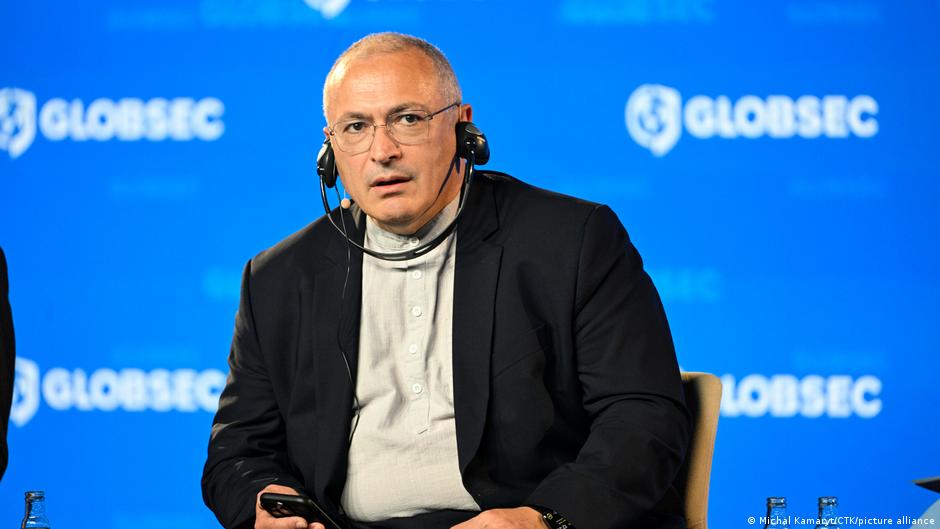
European governments should offer influential members of Russia’s elite a credible alternative to continued support for President Vladimir Putin, according to Russian public figure Mikhail Khodorkovsky, who argues that such an approach could encourage divisions within the Kremlin’s governing coalition.
Speaking on Tuesday, November 3, at a conference of the Russian Anti-War Committee in Brussels, Khodorkovsky said powerful Russians remain aligned with Putin partly because they cannot be confident that their position would improve under a different political order. The calculation facing these insiders, in his account, is therefore not merely ideological but also institutional and economic: loyalty offers a degree of predictability, while defection carries unclear personal and financial consequences.
Asked whether domestic actors could remove Putin, Khodorkovsky pointed to the extensive personal security system constructed by the Russian president. Any European strategy intended to influence Russia’s internal balance of power would consequently need to address the incentives surrounding senior officials, business figures and other influential constituencies rather than assume that dissatisfaction alone will produce political action.
“If we are talking about a split in the elites, then we need to demonstrate opportunities for an individual exit,” Khodorkovsky said.
He acknowledged that such an exit could still involve losses for those concerned. However, he described Europe’s failure to establish pathways of this kind by the fifth year of the war as a serious strategic error. He did not specify the terms at the conference. In earlier writing, he argued that a declaration of disagreement would not be sufficient for people who had cooperated with the regime, citing donations to Ukraine and testimony to investigators about alleged regime crimes as examples of potentially meaningful action.
Transition risks carry long-term economic consequences
Khodorkovsky’s argument extends beyond the immediate question of elite defections. In his opening remarks, he warned that efforts to prosecute people connected with the war or restrict their rights during a future political transition could provoke armed resistance inside Russia.
Millions of Russians, he said, are connected to the war because they or their relatives have fought, worked at military enterprises or supported the political order established by the authorities. Some are accustomed to handling weapons and could resist measures directed against them.
“We must understand that when we speak about lustration, reparations and trials of war criminals, we are speaking about a new war,” he said.
For senior European decision-makers, the warning presents a difficult policy trade-off. Accountability, reparations and legal restrictions may be viewed as necessary elements of a postwar settlement, but their design could also affect Russia’s political stability, investment climate and ability to demobilize a wartime economy. A violent internal confrontation in a nuclear-armed state would carry consequences well beyond Russia, including renewed security spending, disrupted trade and energy flows, migration pressures and prolonged uncertainty for neighboring economies.
Khodorkovsky contrasted attempts to impose a preferred transformation by force with national reconciliation and gradual democratization. In his assessment, armed conflict within Russia would produce another authoritarian government and postpone the prospect of democratic change for an additional political generation.
He issued a similar warning about the potential breakup of the Russian Federation, saying that such an outcome would be paid for in blood. He urged policymakers to discuss not only their desired political destination but also the means used to reach it. The distinction is economically significant: even if a transition promises stronger institutions over the long term, a disorderly route could destroy productive capacity, fragment markets and deepen regional instability before any gains emerge.
Institutional de-escalation as a policy objective
Khodorkovsky proposed focusing on what he called “institutional de-escalation,” meaning a reduction in the threat of war through changes to the structure of power in Russia. In his view, even a shift from one-person rule to collective leadership could lower the probability of war. A parliamentary model and greater federalization would reduce that risk further, he argued.
The proposal frames Russia’s system of government as a macroeconomic and security variable. Concentrated political authority can enable rapid military decisions with limited institutional restraint, while collective leadership, parliamentary oversight and stronger regional powers could broaden the number of actors involved in decisions carrying major fiscal and geopolitical costs.
For Europe, Khodorkovsky’s remarks imply that sanctions, legal accountability and support for Ukraine form only part of the policy equation. Governments must also consider how incentives offered to Russian insiders, transition mechanisms and prospective institutional reforms could shape the likelihood of either an orderly political opening or a destabilizing struggle.
The Russian Anti-War Committee’s two-day conference is being held in Brussels on November 3-4 and is focused on scenarios for ending Russia’s war against Ukraine. Its program also includes discussions of sanctions, nuclear risks and the possibility of putting Putin on trial.