Uzbekistan's First ID Card Fee Stirs Debate on Costs, Access and Reform
A viral case involving a low-income family has intensified scrutiny of how states price basic identity access and how benchmark-linked fees shape household burdens.
A debate over the price of a first national ID card in Uzbekistan has moved from social media into a broader policy discussion about how states finance essential public services, after a journalist described a 15- to 16-year-old girl arriving with her parents to obtain her first identity document.
The journalist described the parents as poorly dressed and visibly burdened by hardship. When the fee was announced at the cashier, she wrote, the father's hands trembled as he opened his wallet and began counting the money inside, while the girl looked first at him and then at the ground.
“He opened his wallet and began counting even the last small coins one by one,” journalist Dilnoza Qurbonova wrote, describing the father's distress and the girl's reaction.
The episode has crystallized a wider question: how fair is it to charge a state fee for the first identity document a child receives as they enter adulthood, and how does Uzbekistan's approach compare with other states?
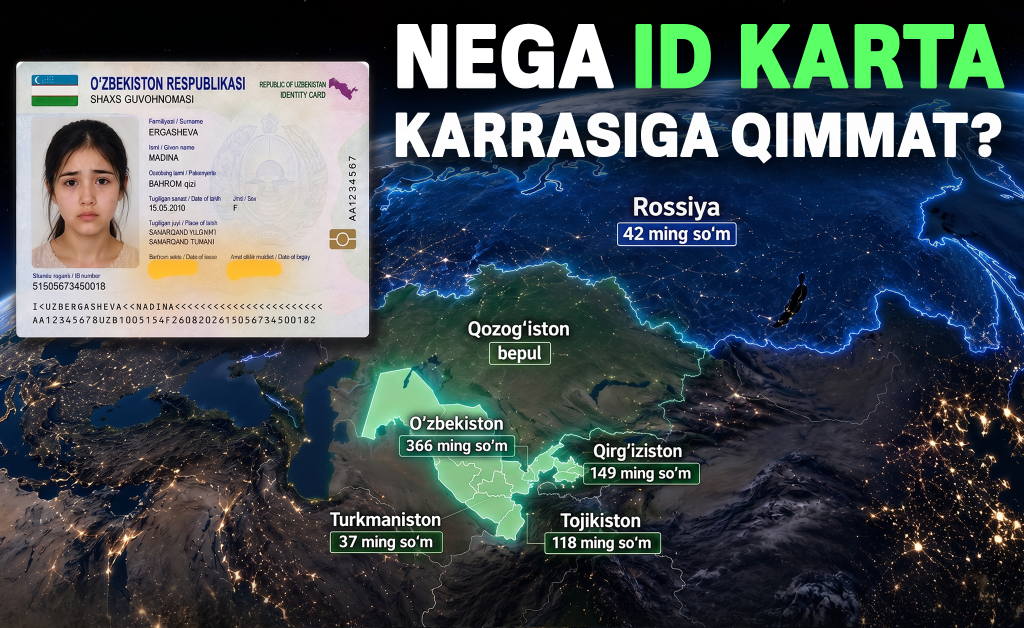
In Uzbekistan, the answer is tied directly to the base calculation amount, or BHM, a benchmark used to set multiple public charges. For a first ID card, applications submitted through a migration department, a public services center or a consulate incur a state duty equal to 89% of the BHM. With the BHM currently set at 412,000 Uzbek soums, that means a fee of 366,680 soums. Applications filed online through my.gov.uz are priced at 80.1% of the BHM, or 330,012 soums.
That structure turns identity pricing into a moving fiscal variable. The BHM has stood at 412,000 soums since August 1, 2025, and is scheduled to increase to 440,000 soums on September 1, 2026. If the fee percentages remain unchanged, the first ID card will then cost 391,600 soums through offline channels and 352,440 soums through my.gov.uz.
When Identity Access Tracks Fiscal Benchmarks
For senior decision-makers, the significance extends beyond a single administrative payment. A first identity document is the entry point to formal interaction with the state and the economy. Pricing that document off an adjustable benchmark means access costs can rise automatically even if policymakers do not revisit identity policy itself.
The lower online fee also shows a second policy objective: nudging applicants toward digital channels. But because both online and offline tariffs are pegged to the same benchmark, the digital discount does not shield households from broader fee inflation. That creates a structural tension between administrative efficiency and the affordability of a basic civic credential.
The public response underscores that tension. What might otherwise appear to be a technical fee schedule is now being interpreted through the lens of household vulnerability, social equity and state legitimacy. For governments pursuing formalization, digitalization and broader service uptake, the pricing of first-time identity documents can carry effects far beyond the registry desk.
Regional Comparisons Reveal Diverging Policy Choices
A comparison across eight countries suggests that Uzbekistan sits at the higher end of first-time identity costs among regional peers, while others are moving toward lower charges or targeted exemptions.
Kazakhstan has taken the clearest step toward de-linking first-time identification from household cost. From January 1, 2026, every citizen turning 16 can receive an ID card free of charge for the first time, and renewal after expiry is also free. The waiver also applies to people receiving the document for the first time after age 18, to those taking Kazakh citizenship, and in some other cases. The initiative is explicitly aimed at reducing the financial burden on citizens and simplifying documentation procedures.
Kyrgyzstan still charges for first issuance, but at a lower level. A standard first ID card issued within 12 working days costs 1,103 Kyrgyz soms, which is about $12.6, or 149,000 Uzbek soums at the current exchange rate. That makes it roughly 2.5 times cheaper than Uzbekistan's current offline fee of 366,680 soums.
Tajikistan charges $10 for an ID card, collected in somoni at the exchange rate on the date of payment. Processing is set at up to 15 days. At the official exchange rate published by the Central Bank of Uzbekistan on August 21, that equals about 118,000 Uzbek soums, or around 3.1 times less than the fee now charged in Uzbekistan.
Turkmenistan does not use a separate national ID card, with the biometric passport serving as the main identity document. According to the State Migration Service, the state duty for that passport is 60 manats, which is estimated at about $3.2 or 37,000 Uzbek soums at the black-market exchange rate. Children under 16 are exempt from the payment, making the cost about 10 times lower than Uzbekistan's current first ID card fee.
Russia issues an internal passport once citizens reach age 14. The state duty for first issuance is 300 rubles, or about $3.6 and 42,000 Uzbek soums at the current rate, approximately 8.7 times less than Uzbekistan's current fee. Under Russia's Tax Code, the same 300-ruble duty applies both to first issuance and to standard replacement, while a lost or unusable passport costs 1,500 rubles to replace.
Turkey's main identity document, the 'Turkiye Cumhuriyeti Kimlik Karti,' is priced at 220 Turkish lira in 2026, or about $5 and 59,000 Uzbek soums. But if a child's birth is registered within the period established by law and the first card is issued on that basis, no fee is charged. Cards issued later than that deadline or provided as replacements cost 220 lira.
Azerbaijan issues identity cards from age 15. According to the Interior Ministry, the state duty for standard issuance within 10 days is 5 manats.
The policy signal is clear. Uzbekistan's current model ties a foundational document to a benchmark that is already scheduled to rise on September 1, 2026, while several peer systems either charge materially less or waive the fee in at least some first-time cases. That does not resolve the fairness debate on its own, but it does frame it as a strategic choice between revenue-linked administration and lower-cost civic inclusion, with long-term implications for how households experience the state.