Serbia’s Election Tests Vucic’s Rule as Student Movement Surges
A mass opposition rally and narrowing polls have raised the prospect of a political realignment with significant policy implications.
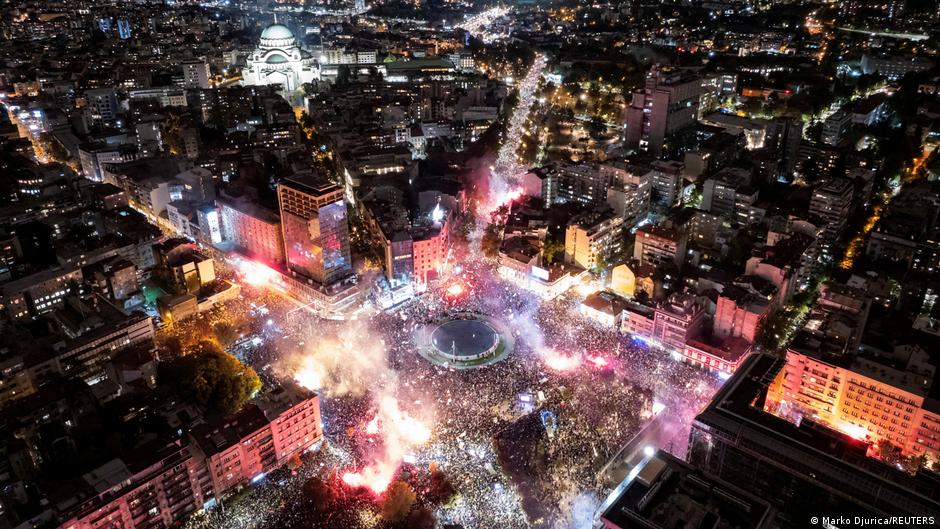
About 150,000 people gathered in Belgrade on Thursday, October 22, according to organizers, in a major opposition demonstration ahead of Serbia’s snap parliamentary election on October 25. The rally underscored the scale of the challenge facing President Aleksandar Vucic and his Serbian Progressive Party, whose long-standing political dominance could be significantly weakened.
The demonstrators called for an end to Vucic’s rule and urged voters to support the Student List, a movement that emerged from a wave of student-led protests and has since developed into a consequential political force. Vucic has served as Serbia’s head of state since 2014 and intends to remain in power despite statements that he would resign, according to the opposition’s characterization of his plans.
The vote presents more than a contest over political leadership. For senior decision-makers, the central issue is whether Serbia is approaching a change in its governing model after years in which political authority has been closely associated with Vucic and his party. A shift in parliamentary control could affect the continuity of economic policymaking, the operation of public institutions and perceptions of governance risk.
Infrastructure tragedy became a governance crisis
The early election follows almost two years of protests triggered by the November 2024 collapse of a canopy at the railway station in Novi Sad. The structure had been renovated shortly before the disaster, which killed 16 people. Serbia’s independent media and opposition groups identified corruption as one of the principal causes of the tragedy.
The accident transformed concerns about the quality of public administration into a national political movement. Students became the main driving force behind large-scale demonstrations, and the Student List grew out of that mobilization. Its rise has placed institutional accountability, the management of public works and the credibility of state oversight at the center of the election.
The election has become a test of whether demands for accountability can be converted into a durable parliamentary alternative.
Those questions also carry economic significance. Allegations surrounding a recently renovated public facility have focused attention on how infrastructure projects are commissioned, supervised and delivered. Irrespective of the election result, sustained public scrutiny could increase pressure for stronger procurement controls, greater transparency and more effective enforcement. For businesses and investors, the credibility of those systems is closely connected to the predictability of the operating environment.
A leaderless movement challenges the established party system
The Student List has adopted an unconventional electoral structure. It has no clear leader, and its candidates will not include professional politicians. Instead, the students want scientists, activists and public figures to represent the movement. Most Serbian opposition parties have withdrawn from the race and called on their supporters to vote for the student-backed list, consolidating much of the anti-government vote behind a single vehicle.
Polling suggests that the strategy could prove effective. A survey by the New Serbian Political Thought project, published on October 20, placed the Student List on 44.5%, compared with 42.7% for Vucic’s Serbian Progressive Party. An equivalent poll in early October recorded support of 44.4% for the Student List and 41.7% for the governing party.
The narrow margins leave the political outlook uncertain. A Student List victory would bring candidates without conventional party careers into parliament, potentially changing the composition and priorities of national policymaking. Its decentralized structure, however, would also face the practical test of translating a protest coalition into coherent government and sustained policy execution.
A victory for the Serbian Progressive Party would preserve substantial continuity. Vucic, whose resignation has been a central demand of the student protesters since 2024, has repeatedly said that he would take that step. In practice, he plans to seek the premiership on October 25 rather than leave power altogether. If his party wins, he would therefore remain at the center of government.
Potential power shift has long-term policy consequences
Serbia’s Constitution gives the prime minister broader powers than the president, although Vucic became the most recognizable figure in the governing establishment during his presidency. He previously served as prime minister from 2014 to 2017, leaving the post after winning the presidential election. Since then, the premiership has continuously been held by members of his party.
His proposed return would amount to a transfer between offices rather than a broader political departure. That possibility has made the institutional balance of power a defining election issue and reinforced opposition claims that formal changes in position would not produce a substantive change in leadership.
For the wider economy, the immediate risk is not a specific policy reversal identified by either side, but uncertainty over the durability and direction of Serbia’s governing institutions. The election could either reinforce the existing concentration of political authority or open a transition toward a less conventional and potentially more plural political structure.
The longer-term consequences will depend on whether the next government can respond to demands for accountability while maintaining administrative capacity and predictable policymaking. With the two leading forces separated by only a narrow polling gap, Serbia’s election has become a closely watched test of political continuity, institutional confidence and the economic consequences of public dissatisfaction with governance.