German Right-Wing Party Expels Politician Mimicking Hitler’s Speech Amid Internal Crisis
Alexander Eichwald’s exclusion from AfD highlights rising tensions and ideological fractures within Germany’s right-wing populist landscape.
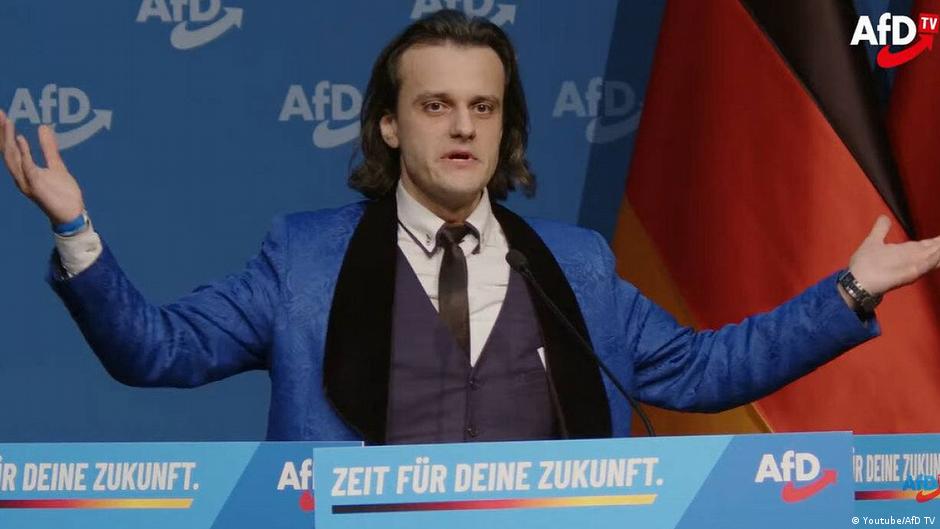
The German right-wing populist party Alternative for Germany (AfD) has expelled 30-year-old politician Alexander Eichwald following a controversy over his public speech style, which closely resembled the mannerisms of Adolf Hitler. The disciplinary court cited Eichwald’s behavior as severely damaging to the party’s reputation and cohesion.
Eichwald, a Russian-born German who emigrated from Rostov-on-Don at the age of nine, first attracted media attention in late November 2025 after his performance at the AfD youth wing "Generation Germany" congress in North Rhine-Westphalia. His exaggerated gestures, elongated vowels, and peculiar rolling of the letter "r" evoked the infamous oratory style of Nazi Germany’s dictator.
Despite immediate backlash, Eichwald defended his speech as a deliberate act. In an interview with Der Spiegel, he explained his intention was to expose latent neo-Nazi tendencies within the AfD leadership by holding a mirror up to society. He likened contemporary Germany’s political environment to the Weimar Republic era, which precipitated Hitler’s rise.
Implications for AfD and German Political Landscape
"The party’s harsh response to Eichwald’s speech effectively reveals its own internal contradictions and raises urgent questions about its ideological trajectory."
The AfD’s disciplinary court decision to remove Eichwald marks a significant moment amid ongoing scrutiny of the party’s far-right elements. While Eichwald retains the right to appeal the ruling at the federal arbitration court, his exclusion underscores the high stakes for AfD as it grapples with maintaining a balance between populist appeal and extremist associations.
This episode also casts a spotlight on the broader challenges confronting Germany and Europe in managing the resurgence of right-wing nationalism. The AfD’s internal fractures reflect wider tensions in European politics, where parties face increasing pressure to distance themselves from extremist rhetoric while responding to populist demands.
Eichwald’s personal background further complicates the discourse. His claim that his speech style was influenced by his Russian upbringing and musical preferences—specifically, learning German through songs by the band Rammstein—provides a nuanced perspective on identity and integration issues within immigrant communities in Germany. Yet, the stark difference between his everyday accent and the theatrical speech at the party congress suggests a calculated performance rather than a mere linguistic quirk.
Moreover, Eichwald’s pointed critique of AfD co-chair Alice Weidel, who previously compared Hitler and Stalin as "spiritual brothers," highlights ongoing disputes about historical memory and the politicization of Germany’s Nazi past. For Eichwald, this comparison was a "slap in the face" and an attempt to downplay the Slavic genocidal campaigns, illustrating the complex interplay of ethnicity, history, and political symbolism in contemporary German politics.
In the days preceding his expulsion, Eichwald doubled down on his stance by publishing a half-hour video on YouTube, where he reiterated his controversial speech style and expressed willingness to repeat the performance. This defiance signals that the AfD’s challenges with managing extremist elements within its ranks are far from resolved.
From a macroeconomic and policy perspective, the AfD’s internal turbulence is significant for Germany’s political stability and its role in the European Union. As Germany navigates economic uncertainties stemming from global shifts and domestic challenges, the rise of radical political factions threatens to complicate policymaking, social cohesion, and international cooperation.
Political fragmentation and the normalization of extremist discourse could hinder Germany’s ability to respond effectively to economic disruptions and geopolitical risks. Senior decision-makers must closely monitor these developments as they represent not only a domestic political challenge but also a factor with potentially broad implications for Europe’s economic governance and integration efforts.