German Military Opt-Outs Surge as Berlin Tests a New Manpower Model
A sharp rise in conscientious objection claims underscores the fiscal, labor-market and policy pressures behind Germany’s defense expansion.
Germany’s effort to rebuild military capacity is exposing a politically sensitive constraint with macroeconomic consequences: the state’s ability to mobilize young people for national defense without disrupting labor markets, public finances and social consent.
From January through the end of August 2026, at least 12,102 people in Germany declared that they did not wish to serve in the country’s armed forces. The applications were filed with the Federal Office for Family and Civil Society Tasks, known as BAFzA, according to the Funke media group, which reported the figures on Monday, October 5.
The increase is striking. In all of 2025, German authorities received 3,879 applications from people seeking to refuse military service. That means the number of objectors in just the first eight months of 2026 was more than three times the total recorded for the whole of the previous year.
The rise is partly linked to the start of questionnaire mailings by Germany’s Defense Ministry. Under a law reforming recruitment for the Bundeswehr that took effect on January 1, 18-year-old men are required from 2026 to complete a questionnaire asking about their willingness to join the German armed forces. Young people are allowed to declare in advance that they refuse service.
BAFzA said many applications contain errors and do not meet the requirements for recognition as justified, meaning they must be returned without review.
The administrative friction matters. A surge in filings that are incomplete or procedurally flawed points to a wider implementation challenge for Berlin: a defense recruitment system that is being scaled up rapidly must also process objections, assessments and voluntary applications efficiently. For senior policymakers and corporate decision-makers, the issue is not only military readiness but the institutional capacity required to manage a larger defense state.
Defense Expansion Meets Demographic Reality
Germany suspended compulsory service in 2011. The new reform does not amount to a full return to universal conscription, but it creates a pathway toward what has been described as military obligation by necessity. Such a mechanism could be partially introduced by a decision of the Bundestag if Germany fails to achieve the required number of volunteers.
The scale of the target is significant. Under Defense Ministry plans, as many as 260,000 people are expected to be serving in the Bundeswehr at the same time by 2035. Reaching that level would require a sustained expansion from current levels and would compete with civilian employers in an economy already facing long-term demographic pressures.
At the end of July 2026, the German Defense Ministry reported that the Bundeswehr had reached its highest number of military personnel in 13 years: 186,700. Compared with July 2025, that represented growth of more than 2 percent, or 3,700 service members.
Those figures show that recruitment is not failing outright. Rather, Germany is seeing two trends at once: rising willingness among some citizens to enter the armed forces and rising resistance among others to the possibility of service. That dual movement is important for assessing the durability of Berlin’s defense build-up. A larger military can be financed through budgets and procurement, but staffing it requires political legitimacy and a steady supply of recruits.
The Defense Ministry has said that of roughly 378,000 people who had been sent questionnaires since the start of 2026, about 2,630 completed the procedure for assessing fitness for service in July alone. That was 35 percent more than in the previous month.
By that point, around 12,100 volunteers and short-term contract service members were already serving under the new recruitment system. That was about 6 percent more than a year earlier.
A Policy Shift With Labor-Market Implications
Germany’s military recruitment push is taking place in a broader European context of elevated security concerns and increased defense spending. For Europe’s largest economy, the consequences extend beyond the defense sector. A sustained increase in personnel needs could affect education-to-work transitions, apprenticeship pipelines, public payroll commitments and regional labor availability.
The Bundeswehr has widened its search for new recruits in recent years, including by setting up a presence at Gamescom, one of the world’s largest video game trade fairs, held in Cologne. That outreach illustrates how the military is competing for attention in the same youth market targeted by technology firms, industrial employers and service-sector companies.
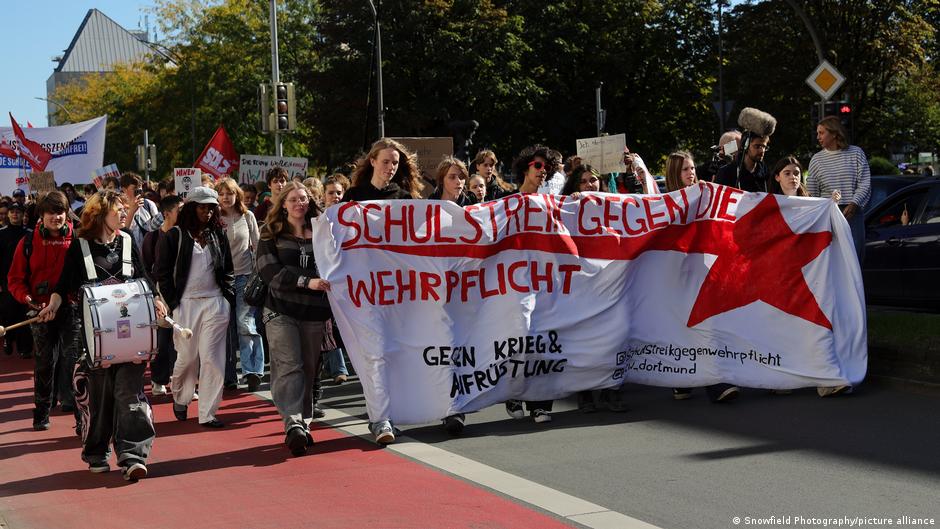
At the same time, the idea of a possible return to military obligation by necessity has drawn criticism from German school students. In September, large protests connected to the issue took place in several German cities. The resistance suggests that recruitment policy may become a recurring domestic political issue, particularly if voluntary numbers fall short of the Defense Ministry’s long-term goal.
For fiscal planning, a larger Bundeswehr implies more than personnel costs. Expanding military headcount also creates demands for training infrastructure, housing, equipment, administration and long-term benefits. If Germany moves toward partial compulsory service, additional administrative systems would be needed to handle questionnaires, objections, medical assessments and assignments. The current rise in flawed objection applications signals that these systems may face pressure even before any broader obligation is activated.
Still, the Defense Ministry has also recorded substantial growth in applications and acceptances for contract military service. In July 2026, 47,300 people submitted such applications, 26 percent more than in the same month a year earlier. By the end of July, the number of new recruits stood at 15,400, an increase of 12 percent compared with 2025.
The resulting picture is mixed but economically consequential. Germany is making measurable progress in growing its armed forces, yet the sharp increase in refusals shows the limits of relying on administrative reform and patriotic appeals alone. The country’s defense strategy now sits at the intersection of security policy, youth politics and labor economics.
For senior decision-makers, the key signal is that Europe’s defense rearmament is not merely a procurement cycle. It is also a human-capital reallocation. Germany’s ability to meet its 2035 military staffing objective will depend not only on budgets, equipment orders and alliance commitments, but on whether the state can design a recruitment system that young people, employers and legislators are prepared to accept over the long term.