Bosnia Vote Extends Dodik Allies’ Hold in Test of Dayton Governance
Preliminary results point to continuity across Bosnia and Herzegovina’s state and regional institutions, with Dodik’s SNSD retaining key leverage.
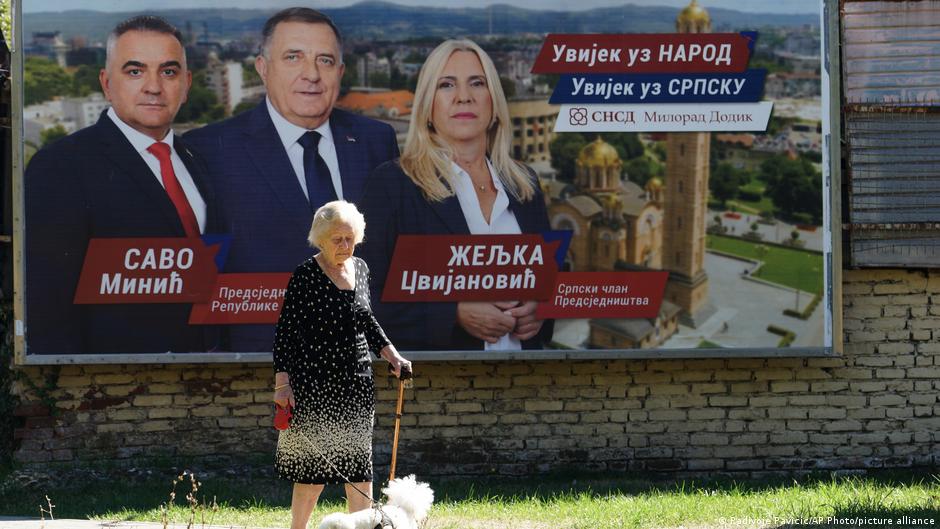
Candidates backed by Bosnia and Herzegovina’s governing parties, including allies of former Republika Srpska president Milorad Dodik, prevailed in elections that underscored the durability of the country’s fragmented postwar political architecture and the economic risks that flow from it.
Savo Minic, the prime minister of Republika Srpska, won the presidency of the Serb-majority region, according to preliminary results. Minic was supported by Dodik, the former regional president known for his close ties to Russia. A Dodik ally, Zeljka Cvijanovic, was also on course to retain a Serb seat in Bosnia and Herzegovina’s tripartite state presidency.
The vote covered members of the state presidency, the central parliament, two regional parliaments and the presidency of Republika Srpska. Preliminary results published by the Central Election Commission on Sunday evening, October 4, indicated that candidates from ruling parties had won across the main contests, leaving the balance of power broadly unchanged.
For senior economic decision-makers, the result matters less as a sudden political shock than as a signal of institutional continuity in a country where complex governance arrangements often shape fiscal policy, investment conditions and relations with external partners. Bosnia and Herzegovina’s system, created under the 1995 Dayton accords, divides political authority among representatives of Bosniak Muslims, Orthodox Serbs and Catholic Croats. The framework ended the civil war, but many analysts regard the resulting system as inefficient.
Preliminary results showed governing-party candidates prevailing across the main races, reinforcing continuity in Bosnia and Herzegovina’s highly decentralized political order.
Continuity in a fragmented presidency
With 95% of ballots counted, Denis Becirovic remained the leading candidate to represent Bosniak Muslims in the state presidency. Becirovic, who had previously served as chair of the presidency, received around 38% of the vote.
Darijana Filipovic was preliminarily set to represent Croats in the presidency with around 48% of the vote. Serb voters favored Cvijanovic, who received around 55% and had already served in the presidency.
Bosnia and Herzegovina has a distinctive presidency in which the duties of head of state are performed jointly by representatives of Croats, Bosniak Muslims and Serbs, who occupy three seats in the presidency. This institutional design is central to the country’s political settlement, but it also creates a policy environment in which consensus-building is slow and political disputes can affect the pace of reform.
For businesses and policymakers, that structure can translate into prolonged decision cycles. Long-term infrastructure planning, budgetary coordination and regulatory alignment depend on cooperation across state and regional institutions. When political continuity preserves stability, it can reduce immediate uncertainty. But when continuity also entrenches institutional gridlock, it can constrain reform capacity and limit the country’s ability to respond quickly to economic shocks.
Republika Srpska result strengthens SNSD position
The main uncertainty in the election was the race for president of Republika Srpska, the Serb-majority entity within Bosnia and Herzegovina. The contest pitted opposition candidate Branko Blanusa against Minic, the region’s prime minister.
Preliminary results showed Minic ahead of Blanusa in most electoral districts in Republika Srpska. Although the opposition candidate won some districts, Central Election Commission data indicated that those gains were not enough to change the overall outcome.
Minic and Cvijanovic both ran for the Alliance of Independent Social Democrats, or SNSD, the party founded by Dodik. Dodik previously served as president of Republika Srpska but was forcibly removed from office in 2025 for failing to comply with decisions of Bosnia and Herzegovina’s Constitutional Court and with international agreements.
The Central Election Commission also reported that SNSD was winning the election to Republika Srpska’s parliament, the National Assembly. Most Bosnian Serbs also voted for the same party in elections to the lower house of the state parliament, the House of Representatives of the Parliamentary Assembly.
The breadth of the SNSD performance suggests the party will retain substantial influence at both regional and state levels, even though Dodik himself is barred by court decision from political activity for six years. Dodik has refused to recognize the court ruling and traveled to Moscow seeking support. Dodik and Minic met Russian President Vladimir Putin in the Kremlin on September 29.
Economic implications of political durability
The electoral outcome reinforces a familiar macroeconomic dilemma for Bosnia and Herzegovina: political stability in personnel does not necessarily mean institutional efficiency. The continued strength of ruling parties may offer near-term predictability, but it also preserves the same governance structure that analysts have long criticized as cumbersome.
That matters for public finance, foreign investment and external alignment. Bosnia and Herzegovina’s layered institutions require coordination between central and regional authorities, and political disputes can delay decisions with economic consequences. The performance of Dodik-linked candidates also keeps attention on Republika Srpska’s relationship with the central state and on the role of Russia in regional politics.
For European and international stakeholders, the vote is likely to be read as a confirmation that Bosnia and Herzegovina’s post-Dayton system remains resilient but difficult to reform. The country’s economic trajectory will depend not only on who holds office, but on whether its political institutions can produce coherent policy at a pace that matches external pressures and domestic development needs.
The immediate message from the preliminary results is one of continuity: Becirovic, Filipovic and Cvijanovic are positioned to shape the state presidency, while Minic’s victory in Republika Srpska and SNSD’s parliamentary strength preserve the influence of Dodik’s political network. The longer-term question is whether that continuity will provide a platform for economic coordination or deepen the structural inefficiencies that have defined Bosnia and Herzegovina’s governance since Dayton.