Dmitriev’s Prison Health Case Underscores Russia’s Institutional Risk
The historian’s return to a penal colony without a diagnosis highlights governance strains with implications for Russia’s legal and economic climate.
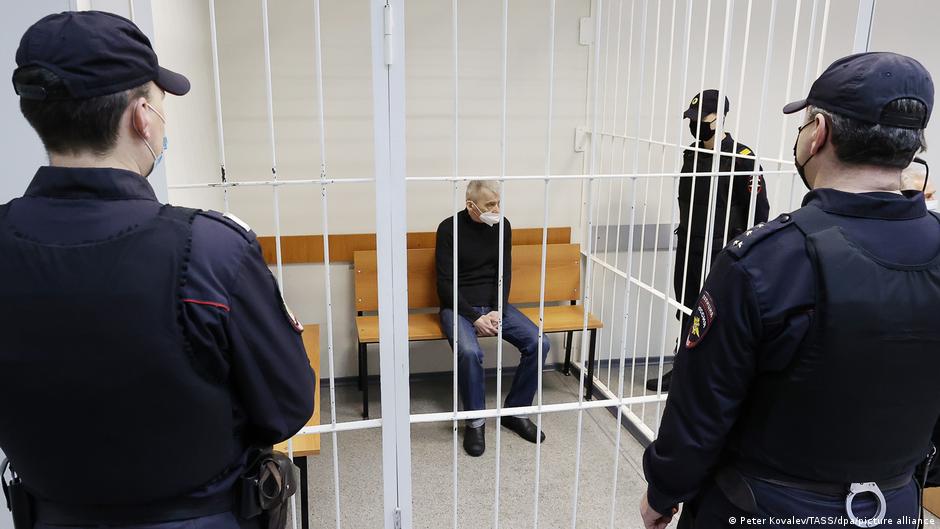
Russian historian Yuri Dmitriev, the former head of Memorial in Karelia, has been returned from a prison hospital to a penal colony without a diagnosis after being sent for treatment with signs consistent with a possible stroke. The case, while centered on an individual prisoner, carries wider significance for senior decision-makers assessing Russia’s institutional environment, rule-of-law trajectory and long-term economic risk.
According to the human rights project Za Prava Cheloveka, which reported the case on Telegram on Tuesday, October 13, citing an unnamed representative of Dmitriev’s support group, the prison hospital lacked the equipment needed to establish whether he had suffered a stroke. Dmitriev was instead given a course of injections, but his supporters said they did not know what medication had been administered.
“His condition is not very good. There was a suspicion of a stroke, but no diagnosis was made: the hospital has no equipment for diagnostics,” the representative told the rights group.
The same representative said Dmitriev had been prescribed bed rest until October 28, but that the penal colony had apparently not been informed and was not allowing him to lie down. She later added that the colony may have received the information about bed rest. The representative also said Dmitriev had been placed several times in a punishment cell for alleged disciplinary violations, including an unfastened top shirt button, sitting on a bed and feeding a cat.
Dmitriev was urgently hospitalized on September 25 from Penal Colony No. 18 in Potma, Mordovia, to a medical correctional facility in the settlement of Barashevo. The online outlet Current Time reported that he had severe weakness, impaired coordination and was unable to stand on his own.
A governance signal beyond one prison case
For economic policymakers, investors and executives, the episode is not only a human rights matter. It is also a signal about institutional capacity inside Russia’s state system. Penal healthcare, court procedure and administrative discipline are not separate from the broader operating environment. They form part of the state infrastructure that determines legal predictability, bureaucratic reliability and the credibility of official commitments.
When a high-profile prisoner reportedly cannot receive a diagnosis because a prison hospital lacks equipment, the issue points to more than medical provision. It raises questions about resource allocation, administrative accountability and the practical functioning of state institutions under stress. These factors matter for macroeconomic analysis because weak institutional quality can compound long-term constraints on productivity, investment and human capital.
Dmitriev is known for compiling and publishing Books of Memory dedicated to victims of political repression in Karelia in the 1930s and 1940s, as well as materials on the history of construction of the White Sea-Baltic Canal. He also discovered mass burial sites of repression victims in Sandarmokh and Krasny Bor. His work placed him at the intersection of historical research, civil society and the politics of memory, all areas that have become increasingly sensitive in Russia’s public sphere.
The criminal prosecution of Dmitriev began in 2016, when the first case was opened against him on suspicion of producing pornographic images of his adopted daughter. A court acquitted him, but in 2018 a new case was opened. On July 22, 2020, a court in Petrozavodsk sentenced him to three and a half years in a strict-regime penal colony on charges of sexual violence against a minor. In September 2020, the Supreme Court of Karelia toughened the sentence to 13 years in a strict-regime colony.
Dmitriev was also accused of producing child pornography, committing lewd acts and illegal possession of weapons. On December 27, 2021, the Petrozavodsk City Court issued a final sentence for Dmitriev, then 65, of 15 years in a strict-regime colony, taking into account the previously imposed term.
Dmitriev has not admitted guilt. On March 15, 2022, the Supreme Court of Karelia rejected his appeal. His supporters have argued that his prosecution was connected to his human rights activity and his work to restore the memory of victims of repression. Calls for his release came from the European Union, as well as from scholars and cultural figures in various countries.
Legal friction and economic isolation
The case also fits into a larger pattern of legal confrontation between Russia and European institutions. In March 2026, the European Court of Human Rights in Strasbourg ordered Russia to pay Dmitriev, who remains imprisoned, 2,000 euros in compensation for moral damage caused by excessively lengthy pretrial detention and the absence of a fair trial. Kremlin spokesman Dmitry Peskov said at the time that Moscow did not recognize the court’s decision.
That rejection has implications beyond a single judgment. For macroeconomic observers, Russia’s stance toward international legal institutions is part of the broader decoupling of its legal and economic systems from European frameworks. This affects not only diplomatic relations but also the perceived enforceability of rights, contracts and remedies involving Russian jurisdiction. Over time, such perceptions influence the risk premia demanded by counterparties, the willingness of firms to maintain exposure and the durability of cross-border economic ties.
The Dmitriev case therefore operates on two levels. On one level, it concerns the immediate health and legal status of a jailed historian reportedly returned to a penal colony without a diagnosis after symptoms that prompted emergency hospitalization. On another, it reflects the continuing erosion of institutional trust that senior decision-makers factor into assessments of Russia’s long-term economic outlook.
Human capital, legal certainty and state capacity are foundational to sustainable growth. Cases involving prominent civil society figures can become indicators of the direction of policy and governance, especially when they involve courts, prisons, medical access and the state’s response to international rulings. For Russia, the long-term economic consequence is not captured in a single budget line or quarterly indicator. It lies in the cumulative cost of weakened institutions, constrained civic space and diminished confidence in the predictability of public authority.