Ukraine Says 28 Killed in Russian Barrage as Sanctions Debate Sharpens
Kyiv says the latest missile and drone assault underscores how energy revenues and weaker sanctions signals may prolong Russia’s war economy.
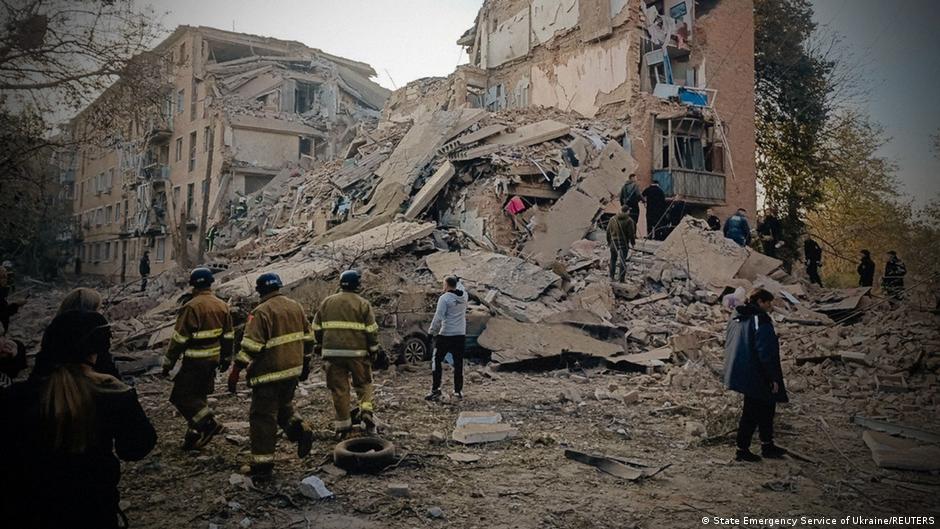
Ukraine said 28 people were killed after a large-scale Russian attack involving missiles and drones, a strike that Kyiv framed not only as another deadly escalation in the war but also as a test of Western resolve on sanctions, energy revenues and the economic costs of prolonged conflict.
Ukrainian Interior Minister Ivan Vyhovsky said in a Telegram post on Wednesday evening, October 7, that 28 people had died as a result of the mass shelling by Russian forces. According to him, emergency service workers and police officers were able to pull people from rubble, evacuate them from damaged buildings and rescue them from fire. In total, 29 people were extracted, evacuated or saved, he said.
Vyhovsky added that rubble-clearing operations in Pryluky had continued for more than 14 hours after a missile struck a residential apartment building. The city, in Chernihiv region, became the focal point of the casualty toll from the attack.
President Volodymyr Zelensky said later the same evening that 100 people had been wounded in the attacks. He described the strike as a combined assault involving many ballistic missiles, many cruise missiles and Shahed drones, followed during the day by additional drone and aerial bomb attacks.
“The strike was combined: many ballistic missiles, many cruise missiles, Shaheds,” Zelensky wrote, calling it a deadly escalation against civilians.
According to Zelensky, Russian forces attacked 13 regions of Ukraine on October 7, using 70 missiles, including many ballistic missiles, as well as Shahed drones. The scale of the attack points to the continued capacity of Russia’s military to sustain broad, simultaneous pressure across Ukraine, despite repeated rounds of Western sanctions and export controls.
Sanctions, Oil Revenues and the War Economy
For senior economic decision-makers, the Ukrainian government’s response to the strike is notable for how directly it links battlefield violence to sanctions policy and commodity revenue. Zelensky argued that weakening sanctions against Russia, and signals about lifting sanctions on oligarchs, send Moscow a message that the war is being normalized.
In Zelensky’s formulation, the issue is not only military. It is also financial. He said that President Vladimir Putin still can sell oil and that, when Russia counts profits in dollars and euros, the war still pays. In Kyiv’s view, this creates an incentive structure in which continued military aggression remains economically viable.
That argument places the latest attack within a broader macroeconomic debate. Western governments have tried to constrain Russia’s capacity to finance the war through sanctions, asset freezes, trade restrictions and limits related to energy markets. Yet Ukraine’s leadership is warning that any relaxation, loophole or political hesitation can reduce the pressure on Moscow and alter the cost-benefit calculation behind continued escalation.
Zelensky stressed the importance of leaders not remaining silent about what happened and about what he described as Russia’s intention to keep moving in the same direction: toward escalation, killings and shelling. He said Putin does not feel that such actions create problems for him.
The warning is aimed at Europe and the wider Western world as much as at Ukraine’s immediate security partners. Zelensky said the issue is not only a problem for Ukraine and its people, but for everyone in Europe and the Western world. That framing turns a military strike into an economic and strategic policy question: whether the international system is imposing enough cost to deter further attacks, or whether fragmented enforcement and sanctions fatigue are allowing the war to become a tolerable expense for Moscow.
Pryluky Casualties Deepen Civilian Toll
The human cost of the October 7 attack was particularly severe in Pryluky, where rescue teams spent the day clearing rubble after the Russian missile strike. Vyhovsky said 20 people were killed there, including five children. Three of the children were one year old.
Vyacheslav Chaus, head of the Chernihiv regional military administration, had earlier reported more than 50 injured as a result of the attack. The figures reported by Ukrainian officials show how a single strike on residential infrastructure can rapidly create a large emergency response burden, from medical care and evacuation to rubble removal and temporary shelter.
For Ukraine’s economy, repeated attacks on cities and civilian infrastructure carry cumulative consequences beyond the immediate death toll. They disrupt local labor markets, destroy housing stock, divert public resources toward emergency response and reconstruction, and raise the long-term fiscal burden on a state already dependent on external financing. Each major attack also reinforces the need for air defense procurement and civil protection spending, areas that compete with social and economic recovery priorities.
The latest barrage therefore adds to a broader pattern in which security shocks shape Ukraine’s macroeconomic outlook. Persistent attacks complicate investment planning, increase insurance and logistics risks, and make reconstruction a moving target. They also put pressure on European partners, whose own budgets must balance defense support, refugee-related spending, sanctions enforcement and domestic economic constraints.
Kyiv’s message after the strike was that the war’s economics cannot be separated from its battlefield trajectory. If Russia can continue earning hard currency from oil and interpret sanctions easing as a sign of normalization, Ukrainian officials argue, then the incentive to sustain attacks remains intact. The deaths reported after the October 7 barrage are therefore being presented by Ukraine not only as evidence of Russia’s military escalation, but also as a warning about the long-term cost of insufficient economic pressure.