Ukraine Sanctions Organizers of Russian Duma Vote in Occupied Regions
Kyiv’s move targets 44 individuals tied to Moscow’s parliamentary voting in occupied territories, underscoring a widening sanctions front.
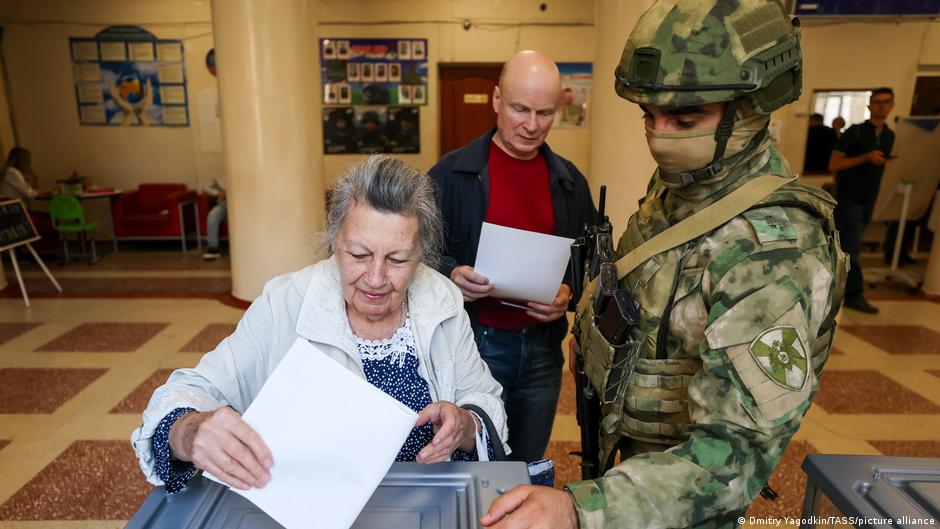
Ukrainian President Volodymyr Zelensky has imposed sanctions on individuals accused of helping organize elections to Russia’s State Duma in territories of Ukraine occupied by Russian forces, a step that further formalizes Kyiv’s rejection of Moscow’s political integration drive in those regions.
The measures, introduced on Saturday, September 27, apply to 44 people. According to the Office of the President of Ukraine, 38 of those sanctioned hold both Ukrainian and Russian citizenship. Ukrainian officials said some of the individuals had previously been “elected” as so-called deputies of illegally created local councils on temporarily occupied Ukrainian territory.
The sanctions follow Russia’s parliamentary elections, held from September 18 to 20. For the first time in State Duma elections, Russian authorities organized voting in the occupied territories of Ukraine’s Kherson, Zaporizhzhia, Donetsk and Luhansk regions. Ukraine and its Western allies have declared both the process and its results illegal.
Ukraine and its Western allies have recognized the voting process and its results as illegal.
The European Union has also stated its readiness to introduce sanctions against people who assisted in holding the vote in occupied Ukrainian territories. That creates the prospect of a broader alignment between Ukrainian and EU restrictive measures, reinforcing sanctions as a central instrument in the diplomatic and economic response to Russia’s actions in Ukraine.
Sanctions as a Tool of Economic Containment
For senior policymakers and investors, the sanctions decision is not only a legal or diplomatic signal. It also reflects the continued use of financial and administrative restrictions to raise the cost of Russia’s attempted institutional consolidation over occupied territory. By targeting organizers and beneficiaries of the elections, Kyiv is seeking to limit the legitimacy, mobility and financial access of individuals linked to Moscow’s governance structures in the occupied regions.
The macroeconomic implications are indirect but significant. Sanctions regimes increasingly shape cross-border risk assessments, financial compliance burdens and the operating environment for companies with exposure to Russia or Russian-linked entities. As Ukraine and the European Union expand lists of sanctioned individuals, banks, insurers, logistics providers and multinational firms face heightened due diligence requirements around counterparties, ownership structures and political affiliations.
The latest Ukrainian measures also fit into a longer-term pattern in which sanctions are used to contest changes in territorial control. Such measures can restrict personal assets and transactions, but they also serve a broader purpose: discouraging administrative cooperation with occupation authorities and signaling that participation in Russian-backed institutions may carry lasting economic consequences.
For Russia, the creation of electoral structures in occupied Ukrainian regions represents part of a wider effort to integrate those territories into federal political and administrative systems. For Ukraine and its partners, refusing recognition of those institutions is essential to maintaining the principle that territorial changes imposed by force do not produce legitimate political or economic status.
Russia Creates Duma Districts in Occupied Territories
For the 2026 State Duma elections, Russian authorities for the first time created separate single-mandate districts for Ukrainian regions occupied after 2022. Following the vote, Russia announced several winners in those districts.
In the self-proclaimed “DNR,” Russia said First Channel war correspondent Irina Kuksenkova and Alexander Borodai, the former “head” of the self-proclaimed republic, had been elected in single-mandate districts. In the self-proclaimed “LNR,” the announced winners were “local parliament deputies” Denis Kolesnikov and Ivan Sanayev. In occupied parts of Zaporizhzhia region, Russia named Alexei Tikhomirov as elected, while in Kherson region it named Elena Dmitruk, described as a deputy chair of the local parliament. All of them ran as candidates of United Russia.
In addition to the single-mandate winners, eight more representatives of the “authorities” in occupied Ukrainian territories entered the Russian State Duma through federal party lists. Among them is Serhiy Arbuzov, a former first deputy prime minister of Ukraine under President Viktor Yanukovych and former head of the National Bank of Ukraine. He was nominated by the party A Just Russia.
The inclusion of such figures illustrates how the political dispute over occupied territory intersects with institutional and economic questions. Arbuzov’s former role at Ukraine’s central bank gives the issue additional resonance for economic decision-makers, because it links the sanctions environment to questions of financial governance, state legitimacy and the reputational risks associated with former officials entering Russian political structures.
Long-Term Policy Consequences
The immediate practical impact of Ukraine’s sanctions will depend on the assets, travel patterns and financial connections of the individuals named. But the broader policy signal is clear: Kyiv intends to treat the organization of Russian elections in occupied territory as sanctionable conduct, and the European Union has indicated it may move in the same direction.
For global markets, this does not represent a single disruptive shock. Instead, it adds another layer to the cumulative fragmentation of Russia-related economic activity. Each expansion of sanctions deepens the compliance perimeter around Russian institutions and individuals connected to the war, making commercial engagement more legally complex and politically sensitive.
Over time, such measures may further isolate the administrative systems Russia is building in occupied territories from international finance, investment and trade. They also strengthen the policy link between recognition, sanctions and economic access: entities and individuals associated with contested governance structures may find themselves excluded from mainstream financial channels even when they operate outside the immediate battlefield.
The Ukrainian decision therefore should be read as part of a wider contest over the economic architecture of postwar accountability. While the battlefield determines immediate control, sanctions help define the longer-term costs of participation in occupation governance and the conditions under which political normalization with Russia could occur.