Kharkiv Drone Strike Highlights Mounting Economic Costs of War
Damage to homes and a production building underscores the widening burden on Ukraine’s workforce, infrastructure and reconstruction needs.
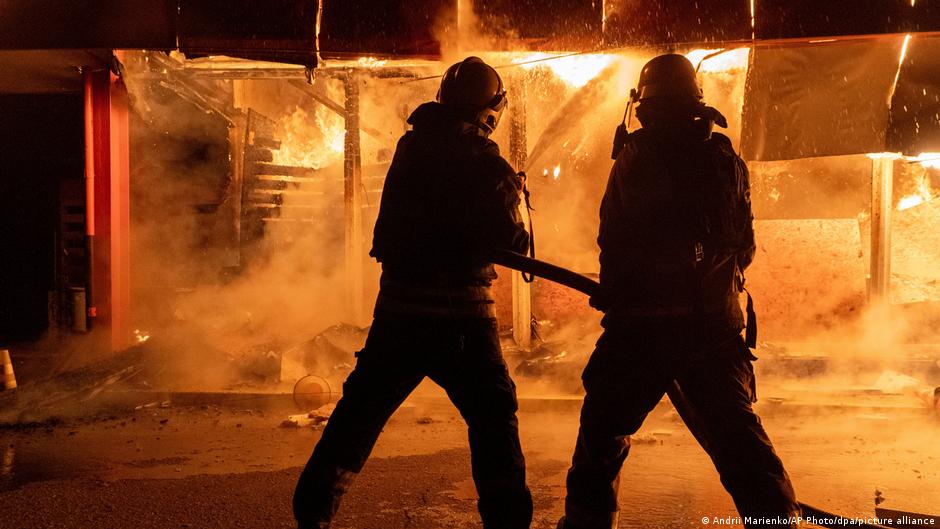
A Russian drone struck a residential building in Kharkiv overnight on Wednesday, October 28, injuring four people, including a four-year-old boy, according to regional authorities. The attack also caused fires in residential properties and a two-story production facility, illustrating how continuing strikes are imposing costs not only on civilian life but also on Ukraine’s productive capacity and long-term recovery prospects.
Oleh Syniehubov, head of the Kharkiv regional military administration, said the attack hit the city’s Osnovianskyi district. A two-story production building, a two-story apartment building and a single-story home caught fire as a result of the strike.
Syniehubov later identified the injured as women aged 32 and 65, a 56-year-old man and the four-year-old boy. Three of the four required hospitalization. Kharkiv Mayor Ihor Terekhov also reported that a Russian unmanned aerial vehicle had hit an apartment building and said people were believed to be trapped inside.
“A hit on a residential apartment building. According to available information, people are trapped inside,” Terekhov wrote.
Damage Extends Beyond the Immediate Strike
For economic decision-makers, the significance of the attack extends beyond the direct physical destruction. Damage to housing affects labor availability, municipal finances and population stability, while a fire at a production facility can interrupt business activity, employment and local supply relationships. The source did not specify the function of the industrial building or the scale of the damage, leaving the immediate commercial impact unclear.
Even without a confirmed estimate, repeated attacks on urban property create cumulative economic consequences. Municipal authorities must allocate personnel and equipment to emergency response, firefighting and building inspections. Residents may require temporary accommodation, medical treatment and social assistance. Businesses exposed to physical damage or security disruptions face additional uncertainty over staffing, operations and investment.
Kharkiv’s position as a major city near the Russian border makes security conditions particularly consequential for its longer-term economic outlook. Continued attacks can complicate efforts to retain residents and skilled workers, restore damaged assets and attract capital. They also increase the burden on public budgets at a time when Ukraine must balance immediate defense and humanitarian requirements with the maintenance of essential services.
Broader Threats Reinforce National Economic Uncertainty
The overnight strike occurred amid warnings of wider aerial threats. The Ukrainian Air Force initially warned of the possible use of ballistic weapons from Russia’s Bryansk region in the direction of Kyiv, but later lifted that alert.
At the same time, messages published through the Ukrainian Air Force’s Telegram channel indicated that attacks involving jet-powered unmanned aerial vehicles and guided aerial bombs continued toward the Kharkiv and Dnipropetrovsk regions, as well as Kyiv and the surrounding region. The geographic spread of those threats points to risks affecting several important urban and economic centers rather than a single locality.
For national policymakers, a sustained threat across multiple regions can require the distribution of emergency, defense and infrastructure resources over a broad area. It can also disrupt transport, production schedules and daily commercial activity even where an incoming threat does not result in a confirmed strike. Alerts and security restrictions generate indirect costs by reducing predictability for employers, workers and service providers.
The combination of residential damage and a fire at a production building also highlights the overlap between humanitarian and economic losses. Housing is part of the infrastructure needed to sustain a functioning labor market, while commercial and industrial premises support incomes, tax receipts and local supply chains. Damage to either category can slow recovery; simultaneous damage to both can deepen pressure on a city’s fiscal and social systems.
Long-Term Reconstruction Burden
The attack adds to the assets that will eventually require repair, replacement or safety assessment. Although authorities provided no monetary estimate for this incident, each damaged structure expands the scope of future reconstruction and creates competing demands for financing, construction capacity and public administration.
For international partners and investors assessing Ukraine’s recovery, the episode underlines the continuing tension between reconstruction and renewed destruction. Capital committed to restoring housing or productive assets remains exposed while attacks continue, raising the importance of security conditions in decisions about project timing, insurance and financing.
The immediate priority in Kharkiv remains the treatment of the injured, assistance to affected residents and emergency work at the damaged buildings. The longer-term implication is a further accumulation of human, municipal and productive losses—costs that will shape Ukraine’s economic resilience during the war and the scale of its eventual reconstruction.