Canada Seeks Role in EU Ukraine Loan as Ottawa Reorients Trade Strategy
Ottawa’s talks to join Europe’s €90 billion Ukraine loan signal a broader effort to deepen transatlantic ties and reduce reliance on the United States.
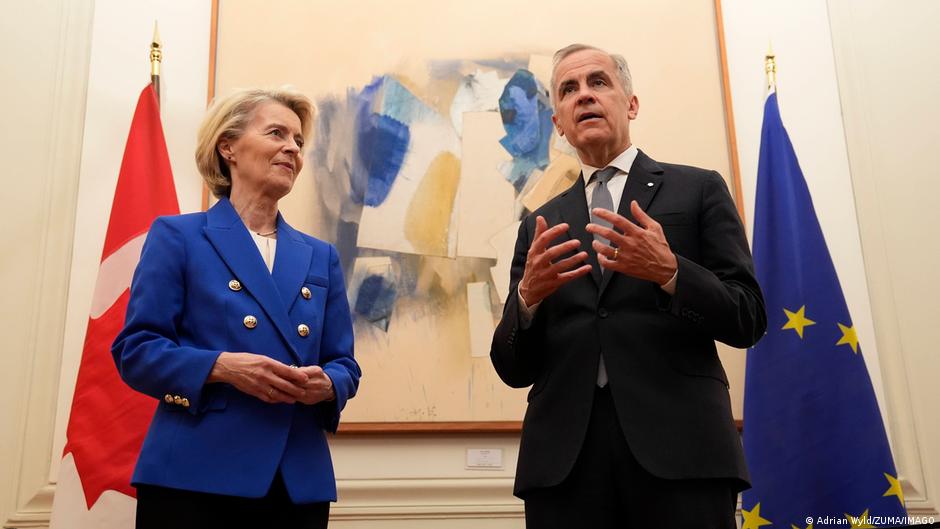
Canada is seeking to participate in the European Union’s loan program for Ukraine, a move that would place Ottawa inside one of Europe’s largest financial support mechanisms for Kyiv and underline a wider shift in Canadian economic and diplomatic strategy.
The EU loan under discussion totals €90 billion. According to the Financial Times, which cited people familiar with the matter, Canada is in talks to join the program and the parties intend to agree on the size of Ottawa’s contribution before the EU-Canada summit scheduled for late October in Montreal.
For senior policymakers and corporate decision-makers, the significance extends beyond Ukraine financing. The talks point to Canada’s attempt to reposition itself within a changing global economic order, where trade frictions with the United States, the financing of European security, and the future of multilateral institutions are becoming increasingly intertwined.
A Financial Commitment With Strategic Weight
So far, the United Kingdom remains the only non-EU country to have joined the loan. Canada’s potential participation would therefore be more than an additional funding source. It would mark a further internationalization of Europe’s Ukraine support architecture and provide Ottawa with a direct stake in a financial instrument designed by the EU.
The timing is notable. The contribution is expected to be settled before the summit in Montreal, giving both sides a deadline to translate political alignment into a concrete economic commitment. For the EU, Canadian participation would reinforce the idea that support for Ukraine is not solely a European fiscal burden. For Canada, it would offer a visible mechanism for demonstrating that its commitment to transatlantic cooperation is backed by capital.
According to the FT’s sources, Prime Minister Mark Carney sees participation in the loan program as a way to show Europe that Canada is committed to strengthening transatlantic ties. That objective is linked to a broader effort to reduce Canada’s dependence on the United States.
Canada’s potential role in the EU loan is therefore both a Ukraine policy decision and a signal about where Ottawa sees its long-term economic partnerships.
The Financial Times reported that Carney’s idea is to create an alliance of liberal powers committed to a multilateral order that, in the paper’s framing, was disrupted by U.S. President Donald Trump. That ambition places the Ukraine loan within a larger political economy agenda: rebuilding institutional cooperation among advanced democracies at a time when U.S. policy remains a source of strategic uncertainty for allies.
Reducing Reliance on the United States
Canada’s search for closer arrangements with the EU also reflects immediate economic pressures. Ottawa is seeking support amid a trade war with the United States, according to the FT, and hopes to conclude other agreements with the European Union.
Those potential agreements include joining the EU’s supercomputer network to collaborate on artificial intelligence and signing a digital trade agreement with Brussels. Taken together, these initiatives suggest that Canada is not merely looking for symbolic diplomatic alignment. It is trying to diversify the infrastructure of growth, technology cooperation, and market access.
For macroeconomic planners, the direction is clear: Canada is examining ways to shift some of its strategic economic exposure from a single dominant neighbor toward a broader transatlantic framework. The Ukraine loan would sit alongside technology and digital trade discussions as part of a package that could gradually deepen Canada-EU integration.
The potential supercomputer link is particularly relevant for long-term competitiveness. Access to advanced computing capacity is increasingly central to artificial intelligence development, industrial productivity, and defense innovation. A digital trade agreement, meanwhile, would be a framework for cross-border data, services, and technology commerce at a time when regulatory blocs are shaping the next phase of globalization.
None of these elements by itself would eliminate Canada’s dependence on the U.S. economy. The United States remains Canada’s primary trade partner and a central factor in its industrial policy. But the policy direction described by the FT indicates a deliberate attempt to reduce strategic vulnerability by building more institutional channels with Europe.
Ukraine Support and Defense Innovation
Canada has already provided Ukraine with military assistance totaling 6.5 billion Canadian dollars, equivalent to about $4.7 billion. On September 10, Carney and Ukrainian President Volodymyr Zelensky signed a declaration on a 100-year partnership that includes cooperation in defense innovation.
That declaration adds another layer to the economic implications of the loan talks. Ukraine policy is increasingly linked not only to budgetary transfers and military aid, but also to defense technology, industrial cooperation, and long-term security commitments. If Canada joins the EU loan program, it would complement an already expanding bilateral framework with Kyiv.
For Europe, wider participation in Ukraine financing may help distribute fiscal and political responsibility among partners aligned with Kyiv. For Canada, it offers a way to anchor its Ukraine policy inside a broader transatlantic economic strategy while strengthening its credentials with European capitals.
The question now is the size of Canada’s possible contribution. That figure has not yet been agreed, and the parties are aiming to settle it before the late-October summit. The amount will determine whether Ottawa’s participation is read primarily as a diplomatic gesture or as a material addition to the financing structure.
Still, even before the number is finalized, the direction of policy carries consequences. Canada is using Ukraine finance, AI infrastructure, digital trade, and defense innovation to pursue a more diversified external economic posture. For decision-makers, the talks are an early indicator of how middle powers may respond to fragmentation in the global order: by building tighter networks among like-minded economies, even when the immediate entry point is wartime financial support.