Trump Threatens EU Trade Halt as Canada Ties Signal New Economic Fault Lines
Washington’s warning over a proposed EU-Canada partnership underscores how trade policy is becoming a central instrument of geopolitical leverage.
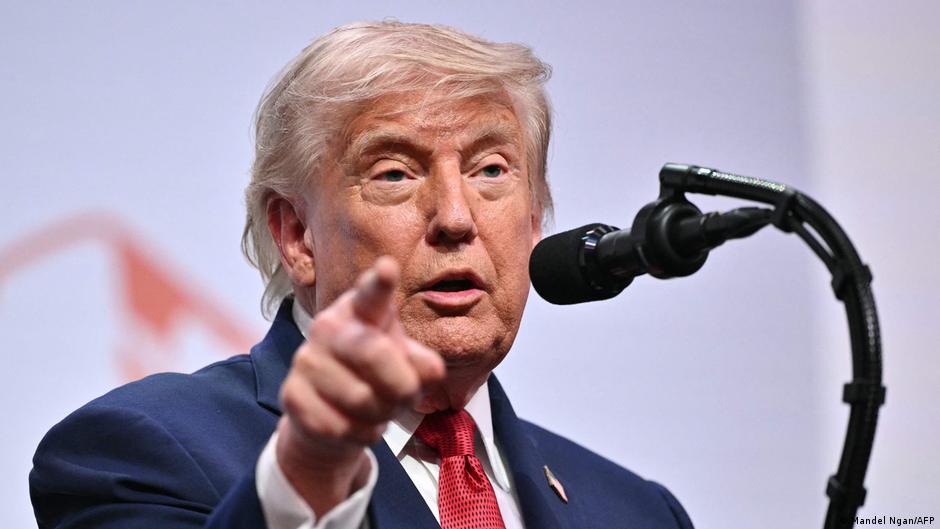
U.S. President Donald Trump has threatened to halt trade with the European Union if the bloc’s partnership with Canada continues to expand, escalating a dispute that points to deeper strains in the global trading system and the growing use of tariffs as strategic pressure.
Speaking on Wednesday, September 16, at a campaign event in North Carolina, Trump responded to European Commission President Ursula von der Leyen’s proposal to make Canada the EU’s “first associate member.” He called the idea “ridiculous” and warned that Washington could respond with steep tariffs or a suspension of trade with Europe if he judged the move to be hostile.
“If they do it and I consider it even in the slightest to be an unfriendly act, I will impose very high tariffs or stop trade with Europe,” Trump said.
Trump added that the outcome would depend on the intent behind the EU-Canada initiative. “If the intentions are good, everything is fine. If the intentions are bad, we will impose very high tariffs on Europe, that is one possibility,” he said.
For senior policymakers and corporate decision-makers, the episode is less a bilateral quarrel than a warning about the fragility of trade assumptions that have underpinned investment, procurement and supply-chain planning for decades. The threat links U.S. access to European markets not to a specific tariff schedule or product dispute, but to the diplomatic architecture of one of Washington’s closest partners.
EU-Canada Alignment Enters Washington’s Trade Calculus
Von der Leyen presented the EU’s ambitions for Canada on September 16 in the European Parliament, where Canadian Prime Minister Mark Carney was present. She said the European Union wanted to take its relationship with Canada to “the highest possible level” and that she intended to work with Carney so that Canada would become the EU’s first associate member.
The European Commission president did not provide detailed terms for such a partnership. She did, however, refer to cooperation in technology and the defense industry, two sectors increasingly central to economic security strategy. Von der Leyen stressed that joint EU-Canada work “will not be directed against others,” and said its purpose would be to make both sides stronger.
That assurance has not prevented the proposal from becoming another flashpoint in Washington’s broader trade posture. Canada and the EU are both affected by what AFP described as Trump’s unpredictable trade and foreign policy. As a result, the agency noted, both Canada and the European Union are looking toward new alliances.
The macroeconomic implications are significant. A closer EU-Canada framework could help diversify trade, technology cooperation and defense-industrial supply chains at a time when firms and governments are trying to reduce exposure to policy volatility. Yet Trump’s response suggests that diversification itself may be interpreted by Washington as a strategic challenge, raising the risk that firms seeking resilience could face new tariff exposure.
Tariffs and Procurement Restrictions Intensify Pressure on Canada
The warning to Europe came as the White House announced a separate measure against Canada. According to a White House press release, Trump signed a memorandum on September 16 providing for a ban on Canadian goods participating in U.S. federal government procurement. Washington said the measures were a response to Canada’s actions, which it described as having “unreasonably introduced new barriers” for American companies seeking access to Canada’s government procurement market.
The procurement restriction adds another layer to a rapidly widening trade confrontation. From September 15, the Trump administration imposed additional 50 percent tariffs on Canadian cheese, steel, aluminum, paper, furniture, lighting fixtures and other goods. Administration representatives said the step was a direct response to Ottawa’s introduction of new tariffs.
Canada’s own tariffs on U.S. exports worth about $20 billion also began to apply on September 15. Those measures were introduced in response to U.S. tariffs that took effect on August 22: a 50 percent duty on Canadian goods worth $20 billion.
The sequence reflects a classic retaliation cycle, but the sectors involved make the economic stakes broader than headline trade balances. Steel and aluminum feed industrial production and construction. Paper, furniture and lighting fixtures affect consumer and business supply chains. Cheese and other food products touch agricultural markets and retail pricing. Federal procurement restrictions add another channel by limiting access to state demand, a key market for many suppliers.
Canada had already exited trade negotiations with the United States on August 21. That withdrawal, followed by successive rounds of tariffs and procurement measures, signals a breakdown in the normal channels used to contain trade disputes before they spill into wider economic planning.
A Broader Test for the Global Trade Order
For the European Union, Trump’s remarks introduce a new policy dilemma. Deepening relations with Canada could strengthen long-term economic resilience, especially in technology and defense production. But doing so now risks drawing the EU into the widening U.S.-Canada confrontation and exposing European exporters to threatened U.S. tariff action.
The threat to “stop trade with Europe” remains a political statement rather than a detailed policy instrument. Still, the significance lies in the direction of travel. Trade policy is being tied to alliance formation, procurement access and perceptions of strategic intent. That creates a less predictable environment for companies deciding where to locate production, source inputs, bid for public contracts or hedge regulatory risk.
For global markets, the immediate issue is not only whether Washington follows through on tariffs against Europe. It is whether major economies increasingly treat trade access as conditional on diplomatic alignment. If that pattern hardens, multinational companies may need to price in higher policy risk across otherwise stable advanced-economy markets.
The EU-Canada initiative, as described by von der Leyen, remains undefined in legal and institutional terms. But Trump’s response has already given it economic weight. A proposal framed in Brussels as a way to elevate cooperation with Canada has become a test case for how far the United States is prepared to go in using trade restrictions to shape the external partnerships of its allies.