Trump Proposes Hosting Another FIFA World Cup in US Without Canada and Mexico, Considering China as Co-Host
US President Donald Trump suggests the United States host the next World Cup independently or with China, signaling shifts in international sports hosting and economic diplomacy.
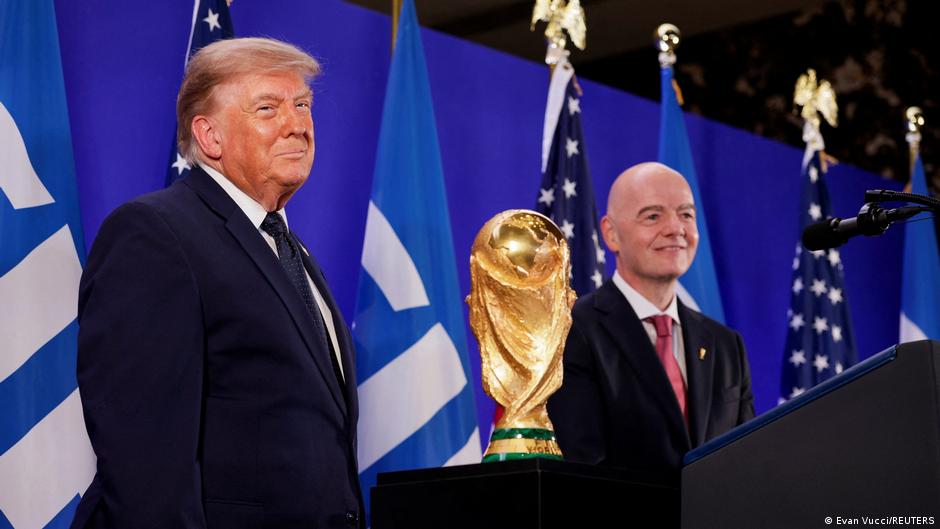
Former US President Donald Trump has publicly advocated for the United States to host another FIFA World Cup, proposing significant changes to the collaborative hosting model established for the 2026 tournament. Speaking at a press event alongside FIFA President Gianni Infantino in New York, Trump advocated for the US to independently host the next tournament without the participation of Canada and Mexico, countries that co-hosted the 2026 World Cup with the US.
Shifting Dynamics in Global Sports Hosting and Economic Influence
Trump asserted, "Next time you should choose the US again. This time, we will host the World Cup without Canada and Mexico. I was very generous before allowing them to join. Now, we will go without them, choose ourselves, and next time invite someone else." This statement marks a notable departure from the current North American collaboration model, reflecting a desire for greater US control over events with significant economic and geopolitical impact.
Further emphasizing strategic international partnerships, Trump revealed that FIFA President Infantino had already agreed with the idea to co-host the next World Cup in the US alongside China. Trump highlighted logistical advantages, noting, "Players will have short flights between games, which I think they will appreciate." The prospect of involving China as a co-host introduces a new dimension to global sports diplomacy, potentially enhancing economic ties amid ongoing geopolitical competition.
"Without you, this World Cup wouldn’t have been such an incredible success," said Infantino to Trump, acknowledging the US’s pivotal role in the 2026 tournament.
The 2026 FIFA World Cup, hosted jointly by the United States, Canada, and Mexico, was hailed by Infantino as "the greatest World Cup of all time." Trump himself praised the event as "the most successful sporting event, perhaps in all of human history," challenging prior perceptions that soccer was not a dominant sport in the US. This success underscores soccer’s rising cultural and economic significance in America, with implications for sports marketing, tourism, and urban infrastructure development.
Trump also thanked Infantino for overturning the suspension of US player Folarin Balogun, a decision that had attracted global criticism. "You made a great, great, great decision," Trump remarked. This episode illustrates how sports governance decisions can have broader political and diplomatic reverberations.
The US is expected to host the final match of the 2026 World Cup at the MetLife Stadium in East Rutherford, New Jersey, where teams Argentina and Spain will compete for the championship trophy. Post-match, Trump plans to present the World Cup trophy, reinforcing the event’s prestige and the US's central role in global sports.
Looking ahead, the 2030 World Cup will be hosted by Morocco, Portugal, and Spain, with additional matches in Uruguay, Paraguay, and Argentina, while the 2034 edition is slated for Saudi Arabia. The next open bidding opportunity for hosting the FIFA World Cup will occur for the 2038 tournament, presenting a strategic window for the US to assert its ambitions in global sports and associated economic benefits.
Overall, Trump’s proposals and the evolving hosting landscape signal a potential shift in how major international sporting events may be leveraged for economic advantage and geopolitical influence. The US’s pursuit of exclusive or alternative co-hosting arrangements, especially involving China, reflects broader policy recalibrations amid changing global power structures.