Sanctioned Russian Oil Tanker Distress Call Exposes Shadow Fleet Risks
The MYRA incident off Ireland highlights the economic, regulatory and maritime risks embedded in sanctions-evasion oil networks.
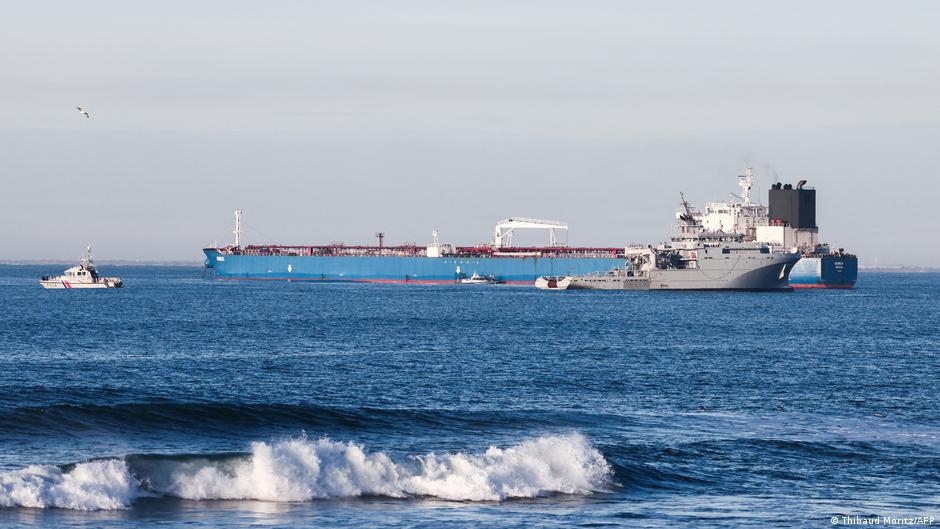
A sanctioned oil tanker associated with Russia’s so-called shadow fleet issued a distress signal in the North Atlantic off Ireland’s northwestern coast, highlighting the growing economic and maritime risks created by the infrastructure used to circumvent Western energy sanctions.
The 75,000-ton MYRA transmitted the alert through the Inmarsat-C satellite system, maritime monitoring project SeaNews reported on Saturday, October 24. The UK Coastguard is coordinating the operation involving the vessel, which is under sanctions imposed by the United States, the European Union and the United Kingdom.
Despite extreme weather, the tanker continued moving at around 9 knots, or approximately 17 kilometers per hour, after departing from the Russian port of Ust-Luga, according to SeaNews. Waves in the area reached 8.8 meters around the time of the distress call, while wind gusts were approximately 130 kilometers per hour. The vessel was estimated to be about 348 kilometers from the coast.
Sanctions enforcement meets maritime risk
The incident illustrates how sanctions policy increasingly intersects with shipping safety, insurance exposure and the resilience of global oil supply chains. Vessels operating within opaque ownership and management structures can complicate emergency coordination, liability assessments and the enforcement of environmental and maritime standards.
According to War & Sanctions, a database maintained by the Main Intelligence Directorate of Ukraine’s Defense Ministry, the MYRA has been used to export Russian oil and petroleum products to third countries while circumventing sanctions. Ukrainian intelligence links the vessel to Fractal Marine DMCC, a company registered in the United Arab Emirates that it describes as one of the leading operators of Russia’s shadow fleet.
The distress call brings the operational risks of sanctions-evasion shipping into the same frame as energy security, trade enforcement and potential environmental liabilities.
Ukraine’s intelligence service says the MYRA has repeatedly called at the Russian ports of Ust-Luga and Primorsk and has also visited ports in Senegal, Turkey, Brazil, Estonia and Denmark. That geographic reach reflects the international character of the trade routes used to move sanctioned oil and petroleum products, involving jurisdictions far beyond Russia and the principal sanctioning economies.
The War & Sanctions database states that the United States added the vessel to its sanctions list on July 30, 2025, followed by the European Union on October 24, 2025. Switzerland and Ukraine listed it on December 13, 2025, the United Kingdom on February 24, 2026, and Canada on March 25, 2026.
Economic implications extend beyond one vessel
For senior policymakers and corporate decision-makers, the central issue is not simply whether one tanker reaches its destination. Shadow-fleet operations can weaken the transmission of sanctions into Russian export revenues while shifting costs and risks elsewhere in the global economy. Governments may face higher monitoring and enforcement expenses, coastal states may bear emergency-response burdens, and legitimate shipping companies may confront uneven competition from operators using less transparent corporate structures.
The accumulation of restrictions across the United States, Europe and Canada also points to a broader policy shift from targeting individual cargoes toward disrupting the networks that own, manage and finance sanctioned trade. The effectiveness of that strategy depends heavily on coordination among port authorities, financial institutions, insurers, flag registries and maritime regulators. Fragmented enforcement can allow vessels and related companies to migrate between jurisdictions or reorganize through intermediaries.
Ukrainian intelligence further alleges that the MYRA belongs to a shipping network controlled by Mohammad Hossein Shamkhani. He is the son of Ali Shamkhani, the former secretary of Iran’s Supreme National Security Council and an adviser to the country’s supreme leader, who was killed in a joint US-Israeli operation in February 2026.
According to the Ukrainian intelligence assessment, the younger Shamkhani controls a network of tankers, operators and shell companies involved in money laundering and the transportation of Russian and Iranian oil, including supplies destined for China. The allegation places the vessel within a wider commercial system connecting sanctioned producers, intermediary companies and major consuming markets.
Those links carry longer-term implications for the structure of global energy trade. If parallel shipping, payment and corporate networks become more durable, sanctions may contribute to a more segmented oil market in which cargoes, financing and maritime services are increasingly divided along geopolitical lines. Such fragmentation could raise transaction costs, reduce transparency and make both price signals and physical supply routes harder to assess.
The MYRA’s distress signal therefore represents more than an isolated maritime emergency. It exposes the operational vulnerabilities of a fleet central to sanctioned oil flows and underscores a policy dilemma: tighter restrictions may increase pressure on targeted exporters, but they also require stronger international capacity to manage the safety, environmental and financial consequences of the alternative networks that emerge.