Putin Signals Conditional Ukraine Talks but Rejects Front-Line Freeze
Moscow’s stance leaves the territorial dispute unresolved, prolonging geopolitical uncertainty and its economic costs for Europe and global markets.
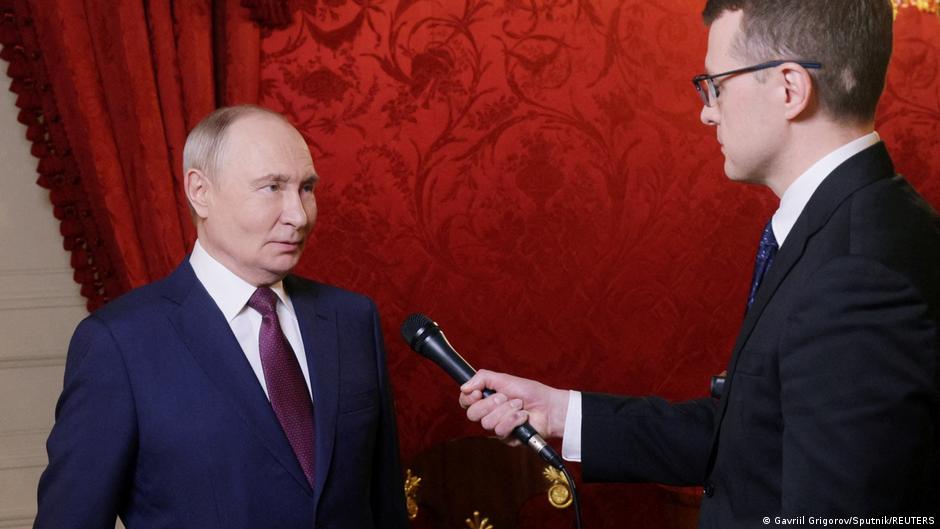
Russian President Vladimir Putin has said Moscow is prepared to resume talks with Kyiv through US mediation, while rejecting a freeze in hostilities along the current front line—an apparent contradiction that limits the immediate prospect of a settlement and extends the economic uncertainty surrounding the war.
In an interview with Pavel Zarubin, a journalist for Russia’s state-owned VGTRK media group, published on Thursday, October 22, Putin said he had agreed during a meeting with US special envoy Steve Witkoff to renew dialogue with Ukraine under Washington’s mediation. He presented the objective as a final peace framework addressing the security of both countries, rather than a temporary suspension of combat.
“We are ready to resume these contacts to achieve this goal,” Putin said, describing negotiations intended to address security after final peace agreements.
Moscow has not disclosed what level of representation it would accept for renewed negotiations. Ukrainian President Volodymyr Zelensky has said he is ready for a three-way meeting with Putin and US President Donald Trump to discuss ending the war. The Kremlin has repeatedly rejected that format or attached conditions Kyiv did not consider a serious basis for talks, including a proposal that Zelensky travel to Moscow.
Territorial demands constrain the diplomatic opening
The latest signal of diplomatic readiness remains constrained by fundamentally incompatible territorial positions. Asked about Zelensky’s statement that Ukraine was prepared to freeze hostilities along the current line of contact, Putin rejected the premise, saying the contested land was “not their territory” but “the territory of historical Russia.”
Trump had reportedly supported the idea of freezing combat along the front line running through the Donbas in 2025, before meeting Putin in Anchorage. Such an arrangement would conflict with Putin’s publicly stated demand that Ukraine surrender the entire Donbas region to Russia without further fighting.
Previous meetings between a Russian delegation selected by Putin and Ukrainian representatives produced no tangible progress toward ending the war. Moreover, only hours after Putin met Witkoff, Russian presidential aide Yuri Ushakov said Moscow was “completely dissatisfied” with proposals brought to Russia by Trump’s negotiators.
For senior economic decision-makers, the gap between Moscow’s willingness to discuss a final agreement and its refusal to accept a front-line freeze is consequential. It suggests that diplomatic activity may continue without materially reducing near-term geopolitical risk. A prolonged conflict would preserve uncertainty around European security spending, sanctions policy, cross-border investment, trade routes and the fiscal burden of military and reconstruction support.
Military activity continues despite peace rhetoric
Putin also claimed that Russia “does not want to fight” Ukraine and shifted responsibility for the continuation of hostilities to Kyiv. He said Moscow remained ready to negotiate and seek a way out of what he called a difficult situation. Putin also described Russians and Ukrainians as one people, citing unspecified recent genetic research, but did not explain how genetics could determine national sovereignty.
The intensity of Russian attacks on Ukraine did not decline after the Putin-Witkoff meeting. On the day Zarubin’s interview was published, Ukrainian authorities reported Russian strikes on civilian sites, including a clothing market in Lozova in the Kharkiv region, Kyiv’s historic center, and roads and bridges in several regions. Two people were killed and 34 injured in the strike on Lozova.
The persistence of attacks complicates efforts to establish confidence around any negotiating process. For governments and businesses, the key distinction is between diplomatic contact and an enforceable reduction in hostilities. Without a ceasefire, security guarantees or convergence on territorial questions, talks alone are unlikely to remove the war-related premium embedded in regional investment and policy decisions.
Long-term costs remain tied to settlement terms
A durable agreement would have implications far beyond Russia and Ukraine. It could influence the future design of European defense, the trajectory of sanctions on Russia, energy-market relationships, infrastructure investment and the scale and timing of Ukraine’s reconstruction. Yet a temporary pause without agreed security arrangements could also leave governments and investors exposed to renewed escalation.
Putin’s insistence on a final settlement rather than a short interruption in fighting therefore addresses a legitimate structural question—whether a deal would be durable—but Moscow’s territorial demands remain a central barrier. Kyiv’s willingness to consider a freeze along the existing line would halt fighting without necessarily resolving sovereignty claims, while Russia’s position would require further Ukrainian concessions.
The result is a negotiating landscape in which all three parties may support renewed contact while disagreeing on its basic purpose and acceptable outcome. Until those differences narrow, the global economic consequences of the war—from elevated public spending and disrupted investment to continued sanctions and reconstruction uncertainty—are likely to persist.