Protest at Russian Pavilion in Venice Biennale Highlights Political Tensions Amid Global Art Event
Activists stage demonstration demanding representation of Russian political prisoners with pro-Ukrainian views at Venice Biennale, underscoring geopolitical divides
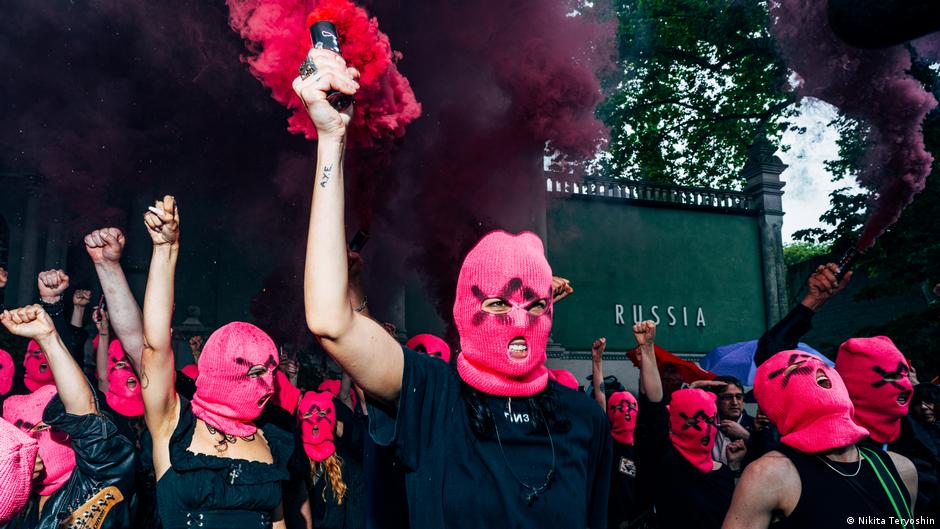
On May 6, feminist punk rock group Pussy Riot and Ukrainian women's movement Femen jointly organized a protest at the Russian pavilion during the Venice Biennale, the world's leading contemporary art exhibition. The activists demanded that Russia be represented by political prisoners who hold pro-Ukrainian views, drawing attention to the ongoing political repression tied to the war in Ukraine.
The demonstrators lit smoke flares in pink, yellow, and blue—the colors of the Ukrainian flag—and chanted slogans such as "Russian art is blood." They carried placards with messages including "Enjoy the show—ignore the war," "Curated by Putin, corpses included," and "Art on display, graves below." Some protestors inscribed these phrases on their bodies, while statues at the pavilion were adorned with Ukrainian flags and masks.
Art, Politics, and International Sanctions
Pussy Riot member Nadezhda Tolokonnikova criticized the participation of Russia at the Biennale, stating, "The best citizens of Russia are either imprisoned for anti-regime and pro-Ukrainian actions or killed in dungeons, while Europe opens its doors to Putin's officials and propagandists." She insisted that those representing Russia at such a prestigious cultural forum should be artists imprisoned for their opposition to the war and their pro-Ukrainian stance.
"Every Russian artwork shown this year stands on an invisible pedestal of Ukrainian blood. You won’t find this in the catalog, but it is the only real material holding this pavilion," declared Femen leader Inna Shevchenko.
Russia’s participation in the Venice Biennale marks its first since the full-scale invasion of Ukraine began. This decision by the organizers ignited sharp criticism across the European Union and from Ukraine itself. The European Commission argued that allowing Russia to participate violated EU sanctions legislation.
In response to the controversy, the Biennale organizers limited the Russian pavilion’s opening to invited guests only from May 6 to 8, during which time a continuous sound performance titled "Tree Rooted in the Sky" was featured. The pavilion was then closed to the general public on May 9, coinciding with the Biennale’s official public opening.
Due to widespread criticism concerning both the Russian and Israeli pavilions, the Biennale jury excluded these countries from award consideration and subsequently resigned. This highlights the complex entanglement of art, diplomacy, and sanctions amid ongoing geopolitical conflict.
Connections Between Art, State, and Defense Industry
The Russian pavilion is managed by Smart Art, a company founded by Ekaterina Vinokurova and Anastasia Karneeva. Notably, Karneeva is the daughter of a retired general and former deputy director of Russia’s state defense conglomerate Rostec, while Vinokurova is the daughter of Russia’s Foreign Minister Sergey Lavrov.
This connection between Russia’s official art representation and high-ranking state and military figures emphasizes how cultural diplomacy intertwines with state power and geopolitics, especially during periods of international conflict and sanction regimes.
For senior decision-makers and policymakers, these developments underscore the increasing difficulties in separating cultural forums from political agendas in times of conflict. The events at the Venice Biennale exemplify how artistic spaces become arenas for geopolitical contestation and soft power struggles with wider implications for international relations and sanction enforcement.