North Korea Fires Ballistic Missile as Peninsula Tensions Add Policy Risk
South Korea said North Korea launched at least one ballistic missile toward the Sea of Japan after a disputed border blast injured three soldiers.
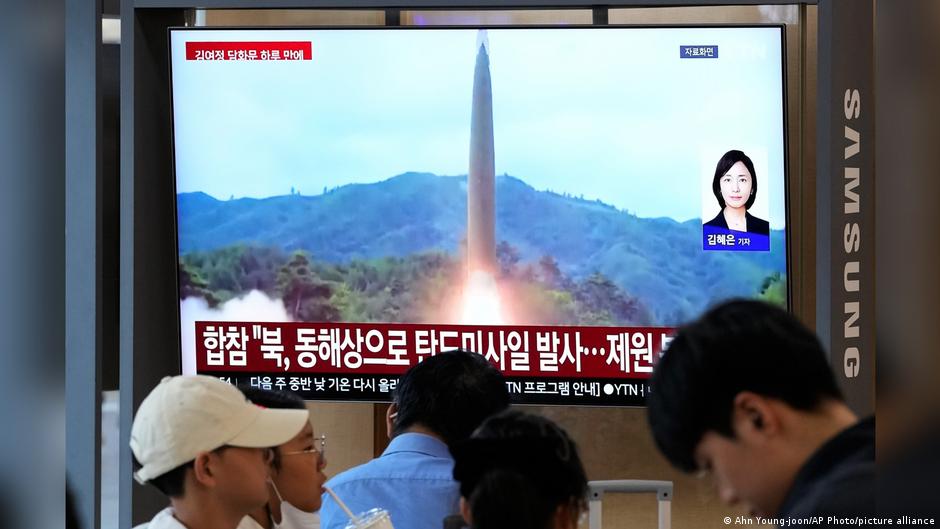
North Korea launched at least one ballistic missile toward the Sea of Japan, South Korea’s military said on Saturday, October 3, adding a fresh security shock to a region already central to global trade, technology supply chains and defense planning.
The announcement by South Korea’s Joint Chiefs of Staff came after Seoul had accused Pyongyang of violating the armistice that ended active fighting in the Korean War, following an explosion in a border area on September 21 that injured three South Korean service members. South Korean authorities believe the incident was caused by North Korean anti-personnel mines, AFP reported, citing South Korean military sources.
For senior economic decision-makers, the missile launch is not only a military development. It reinforces the persistence of geopolitical risk on the Korean Peninsula, where a formal peace treaty has never replaced the 1953 armistice. That unresolved legal and strategic condition continues to shape defense expenditure, investor risk assumptions and the contingency planning of governments and multinational companies with exposure to Northeast Asia.
South Korea, the United States and Japan are maintaining a high level of combat readiness while closely sharing information on North Korean ballistic missiles, Seoul said.
The statement underscores the trilateral security coordination that has become a key policy response to North Korea’s weapons activity. For markets and corporate planners, that coordination can be read as both stabilizing and escalatory: stabilizing because it signals deterrence and information-sharing among major economies, but escalatory because each new launch or border incident can harden security postures and narrow the political space for de-escalation.
Border Incident Raises the Cost of Strategic Uncertainty
The missile launch followed a border-area explosion on September 21 between North and South Korea. Three South Korean soldiers were injured. Seoul believes the blast resulted from the detonation of North Korean anti-personnel mines, according to AFP’s account of South Korean military sources.
South Korean Defense Minister Kang Shin Chul accused Pyongyang of violating the armistice and announced an intention to take retaliatory measures. The Joint Chiefs of Staff demanded that North Korea apologize.
North Korea rejected the accusations. Kim Yo Jong, the sister of North Korean leader Kim Jong Un, called the South Korean claim “extremely low and dirty,” according to North Korea’s state news agency KCNA.
The exchange illustrates why the peninsula remains a recurring source of risk premia in Asia. Even when military incidents are geographically confined, they can trigger political responses that affect broader expectations about defense policy, sanctions enforcement, diplomatic bandwidth and cross-border stability. The Korean Peninsula sits near some of the world’s most important manufacturing and shipping networks, which means security perceptions can matter well beyond the immediate military zone.
The demilitarized zone separating the two Koreas is among the most fortified and heavily mined borders in the world. A military demarcation line runs through the middle of that mined strip. The presence of such infrastructure means that even localized incidents can carry outsized political weight, particularly when they occur amid missile activity and mutual accusations.
Macroeconomic Implications for Northeast Asia
The immediate facts remain limited: South Korea said at least one ballistic missile was fired toward the Sea of Japan; Seoul, Washington and Tokyo are sharing information and maintaining readiness; and the launch came after the disputed September 21 explosion. But the longer-term economic implications are clearer. Persistent tension increases the importance of security policy in economic forecasting for Northeast Asia.
South Korea and Japan are advanced industrial economies deeply embedded in global supply chains. Any deterioration in regional security conditions can force governments and companies to revisit assumptions about continuity, redundancy and exposure. That does not mean disruption is inevitable after every launch. It does mean that geopolitical risk remains a structural variable, not a temporary headline risk, for boardrooms and policymakers.
The United States’ role also matters. The South Korean statement explicitly referenced coordination among South Korea, the United States and Japan. That trilateral alignment has economic as well as military significance because it links regional deterrence policy with broader questions of alliance spending, technology controls, industrial security and strategic resilience.
For policymakers, the episode may reinforce arguments for maintaining high defense readiness and strengthening intelligence cooperation. For investors, it is a reminder that the peninsula’s unresolved war status is not an abstraction. The Korean War ended in 1953 with an armistice agreement, not a formal peace treaty. Formally, North and South Korea remain at war.
That legal and political reality has endured for decades, but its economic relevance rises whenever incidents at the demilitarized zone coincide with missile launches. The risk is not only a sudden crisis, but also a gradual normalization of higher security costs, deeper alliance coordination and reduced diplomatic flexibility.
North Korea’s rejection of South Korea’s allegation shows that the information environment surrounding such incidents is contested. In macroeconomic terms, contested attribution complicates policy signaling. Governments may seek to demonstrate resolve, while markets may struggle to distinguish between rhetoric, deterrence and genuine escalation.
For senior decision-makers, the central takeaway is that Korean Peninsula risk remains a durable constraint on regional stability. The latest missile launch toward the Sea of Japan, combined with Seoul’s accusation over the border blast and Pyongyang’s denial, adds another layer to a strategic landscape in which military readiness, economic planning and long-term policy choices are tightly connected.