Armenian Parliamentary Elections Signal Continued Pro-Western Shift Amid Moscow Tensions
Prime Minister Pashinyan’s ‘Civil Contract’ party leads, reinforcing Armenia’s EU alignment despite Russian opposition.
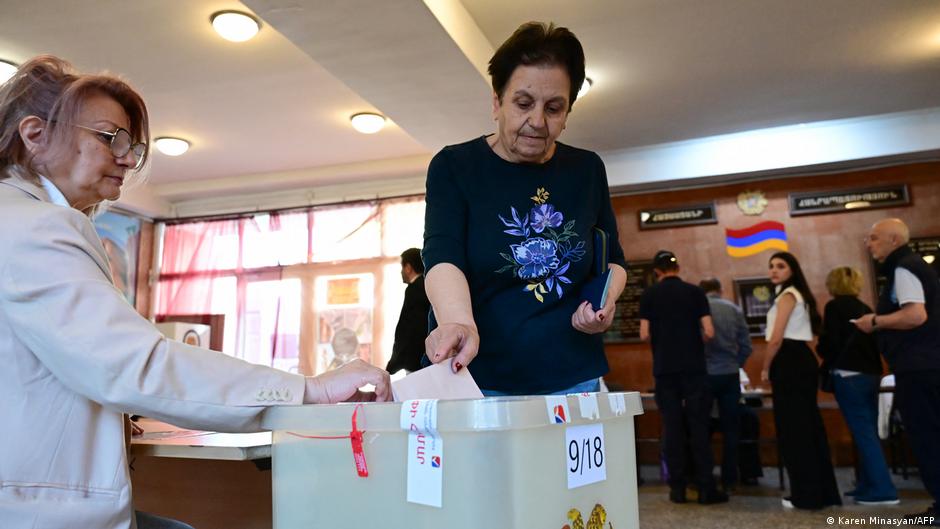
Armenia’s recent parliamentary elections, held on June 7, 2024, have significant implications for the country’s geopolitical orientation and regional economic ties. Preliminary results from the Central Electoral Commission, with over 55 percent of ballots counted, indicate a decisive lead for Prime Minister Nikol Pashinyan’s "Civil Contract" party, which secured approximately 50.86% of the vote.
Election Outcomes and Political Landscape
The Armenian parliament, known as the National Assembly, comprises 105 deputies, including four mandates reserved for national minorities such as Yazidis, Russians, Kurds, and Assyrians. The voter turnout for this election was 58.97%, notably higher than in the 2018 and 2021 elections, signaling increased public engagement.
Opposition forces remain fragmented. The "Strong Armenia" alliance, led by Samvel Karapetyan, an Armenian-Russian businessman, won 23.19% of the vote. The "Armenia" bloc, headed by former President Robert Kocharyan, garnered 9.6%. Other parties surpassing the 4% threshold include the opposition "Prosperous Armenia" with 4.1% and the "Wings of Unity" party at 2.3%. The proportional voting system and threshold rules (4% for parties, higher for coalitions) aim to ensure parliamentary stability, with a majority threshold set at 54%. Failure to reach this could trigger a runoff.
Prime Minister Pashinyan promptly declared victory and intent to form a single-party government, although critics from opposition groups condemned these remarks as premature and potentially unconstitutional, accusing the government of undermining the Central Electoral Commission’s authority.
Macro-Economic and Geopolitical Implications
“The elections reaffirm Armenia’s strategic pivot toward the European Union, signaling a shift that complicates traditional ties with Moscow.”
Since 2025, Pashinyan has legislated a policy course favoring closer integration with the European Union, a move that has heightened tensions with Russia, Armenia’s historically dominant regional partner. Although the Prime Minister insists he does not seek a rupture with Moscow, his government’s EU alignment marks a clear policy divergence from Russia’s interests.
Russia’s response has included trade restrictions targeting key Armenian exports such as alcohol, agricultural products, flowers, and fish, signaling economic pressure amid the political realignment. Russian President Vladimir Putin has publicly compared the Armenian situation to early stages of Ukraine’s crisis, underscoring Moscow’s sensitivity to shifts within its traditional sphere of influence.
The electoral outcome thus has broader ramifications for regional economic stability and energy transit routes, given Armenia’s location and its role within Eurasian economic frameworks. Continued Western integration may attract EU investment and access to markets, but risks exacerbating Armenia’s economic exposure to Russian countermeasures.
Looking Ahead: Stability and Strategic Choices
The election results set the stage for a potentially stable parliamentary majority under Pashinyan’s leadership, which may enable decisive policy implementation favoring European integration. However, political fragmentation and opposition resistance could challenge governance, especially given the polarized geopolitical context.
For international economic stakeholders and senior policymakers, Armenia exemplifies how small states at geopolitical crossroads navigate economic dependencies and strategic alliances. The balance Armenia strikes between its EU ambitions and relations with Russia will influence not only its domestic economic trajectory but also regional trade patterns and security dynamics.