Russian Strikes Kill Four in Ukraine as Civilian Infrastructure Toll Widens
The latest attacks on Kherson, Sumy, Odesa and Kyiv regions underscore the mounting economic strain of repeated strikes on urban and logistical assets.
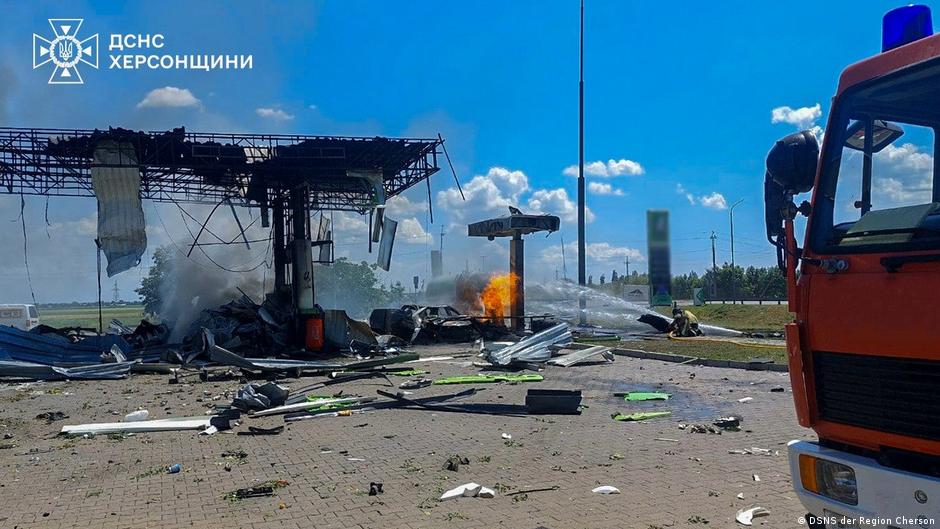
Four people were killed in Ukraine after a new series of Russian attacks struck southern, northeastern and central regions, adding to the human and economic cost of a war increasingly defined by pressure on cities, emergency services and civilian infrastructure.
In the Kherson region, two people died after a Russian drone strike hit the settlement of Tekstylne on Friday evening, September 18, according to regional military administration head Oleksandr Prokudin. He said the attack took place at around 18:00 and that two men sustained injuries incompatible with life.
“As a result of an enemy drone strike, two men received injuries incompatible with life,” Prokudin wrote on Telegram.
Throughout the evening, Prokudin repeatedly reported air raid alerts across the region, including warnings linked to suspected Russian launches of guided aerial bombs. Kherson city also saw an attack on one of its hospitals on September 18, when a drone dropped explosives on the facility’s grounds. No casualties were reported in that incident.
The attacks illustrate a pattern with economic consequences beyond immediate damage: repeated disruption to health care, housing, administration and emergency response systems raises the fiscal burden on local and national authorities while weakening the predictability needed for investment, logistics and reconstruction planning.
Urban Damage and Emergency Response Risks
In the Odesa region, Ukraine’s State Emergency Service reported the consequences of further Russian attacks on September 18. A strike hit an 11-storey administrative building, triggering a fire. After emergency crews arrived and were working at the site, the same building was attacked again.
Ten people were reported injured in the Odesa incident, including two rescue workers. The repeat strike on a site already under emergency response highlights an additional operational risk for authorities: attacks that endanger first responders can slow rescue, firefighting and damage containment, increasing the eventual cost of recovery.
Odesa was attacked again during the night of September 19. After an air raid alert was announced in the city and reports circulated of Russian small missiles approaching, local residents posted footage on social media showing a fire that had started in a residential building within the city. Initial details of the incident were not provided.
For policymakers and senior decision-makers, the Odesa strikes carry broader significance. The city and its region remain important to Ukraine’s commercial geography, public administration and connectivity. Even when individual incidents do not involve strategic facilities, cumulative attacks can affect insurance costs, labor mobility, municipal budgets and the confidence required for postwar rebuilding.
Residential Areas Hit in Sumy
On the evening of September 18, the city of Sumy also came under Russian attack. One munition struck a multi-storey residential building, with reports indicating that it was a guided aerial bomb. The blast damaged several apartments and caused part of the building to collapse.
According to preliminary data from local authorities, at least two people were killed in the Sumy strike and seven others were injured. The damage to residential property adds to Ukraine’s longer-term reconstruction challenge, which includes not only replacing buildings but also sustaining displaced households, local services and municipal revenue bases.
Residential destruction has a direct macroeconomic dimension. Damaged housing reduces household security and labor-market stability, while repeated strikes can push populations away from vulnerable areas. That in turn affects local demand, business continuity and the ability of regional administrations to maintain public services under wartime pressure.
The Kyiv regional military administration also reported consequences from Russian strikes on the evening of September 18. According to regional administration head Tymur Tkachenko, two men were injured in the Bucha district after an attack on warehouse premises. Warehouse facilities were also damaged in the Boryspil district of the region.
Damage to warehouse infrastructure is significant in economic terms because storage sites are part of the logistics networks that support commerce, humanitarian supply and industrial activity. Even localized disruption can force rerouting, increase delivery costs and add uncertainty for businesses operating in or through affected regions.
Economic Pressure Through Repeated Disruption
The latest strikes did not target a single region or asset class. They affected a settlement in Kherson region, a hospital site, an administrative building in Odesa, a residential building in Sumy and warehouse premises in the Kyiv region. That geographic and functional spread is central to the economic impact of the war.
For Ukraine, every new attack compounds immediate emergency expenditure with longer-term reconstruction liabilities. Local authorities must fund rescue operations, temporary repairs, medical treatment, housing support and infrastructure stabilization while operating under persistent threat. National policymakers face the parallel challenge of sustaining defense, public services and reconstruction planning at the same time.
The consequences also matter for Ukraine’s international partners. Continued strikes on civilian and logistical infrastructure reinforce the case for external financing, air defense support and long-horizon reconstruction frameworks. They also complicate assumptions about the timing and sequencing of recovery, particularly in regions where repeated attacks can quickly reverse repair work.
From a macroeconomic perspective, the burden is cumulative. Casualties and damaged buildings are the most visible outcomes, but the wider effect includes higher risk premiums, disrupted local commerce, pressure on municipal balance sheets and uncertainty for investors assessing Ukraine’s future production and logistics capacity.
The reported deaths in Kherson and Sumy, the injuries in Odesa and Kyiv region, and the damage to residential, administrative, medical and warehouse sites together show how the war continues to impose costs across Ukraine’s civilian economy. For senior decision-makers, the key issue is not only the scale of any single strike, but the strategic effect of repeated disruption on resilience, reconstruction and long-term economic stability.