EU to Fund Ukraine Drones and Missiles as War Pressures Policy Agenda
Brussels is preparing additional support for Kyiv as leaders weigh Ukraine’s 2027 financing needs and wider economic risks.
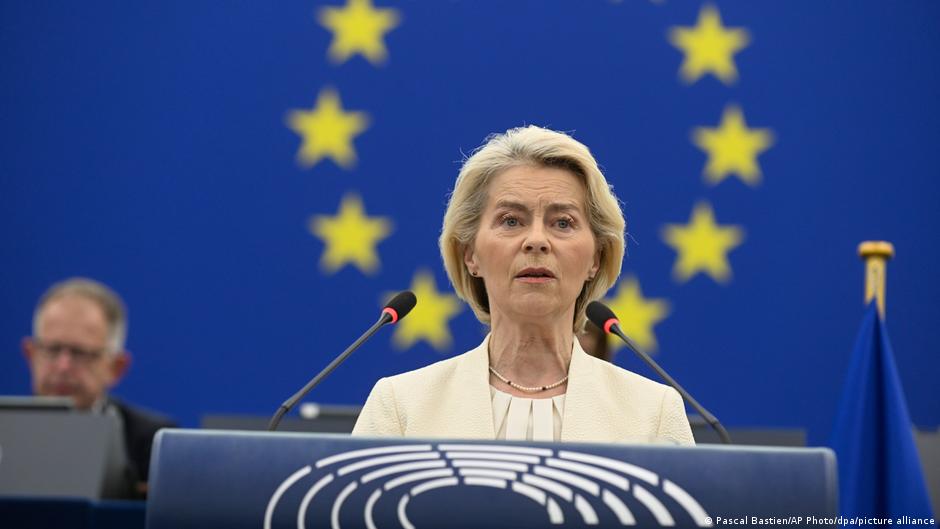
The European Union will allocate additional funding to Kyiv in mid-October for the purchase of drones and missiles, European Commission President Ursula von der Leyen said on Sunday, October 11, placing Ukraine’s military requirements back at the center of the bloc’s economic and political agenda.
Von der Leyen announced the move on X after a telephone conversation with Ukrainian President Volodymyr Zelensky. She said the support was needed to strengthen Ukraine’s defense and protect its airspace. She did not specify the amount of the new financing or identify its funding sources.
“This is necessary to strengthen Ukraine’s defense and protect its airspace,” von der Leyen said.
The timing matters for European policymakers. Brussels said the situation in Ukraine will be one of the central subjects at this week’s European Council meeting, where leaders are expected to discuss financing needs for the coming year and options for mobilizing new international support. For senior decision-makers, the announcement signals that Ukraine’s defense requirements remain closely tied to the EU’s fiscal planning, diplomatic coordination and long-term security policy.
Ukraine Support Moves Deeper Into EU Economic Planning
The additional funding for drones and missiles comes as the EU continues to frame assistance to Ukraine not only as emergency wartime support, but also as a multi-year economic and institutional commitment. Earlier, on October 2, the European Commission approved a 2.9 billion euro tranche for Kyiv under the Ukraine Facility, the mechanism created to provide long-term financial assistance to Ukraine.
The Ukraine Facility covers the period from 2024 to 2027 and is designed to allow the EU to provide Ukraine with up to 50 billion euros in stable and predictable financial assistance over that period. Brussels has repeatedly emphasized predictability as a central feature of the mechanism, reflecting the need to support government financing, reconstruction planning and reform commitments even as the war continues.
Payments under the facility are closely linked to Ukraine’s implementation of a specific recovery and reform plan, as well as to support for democratic mechanisms, the rule of law and human rights. The European Commission has said payments are made quarterly after verification that the conditions for disbursement have been met.
That conditional structure has macroeconomic significance. It ties EU financial flows to institutional benchmarks, giving Brussels leverage over reform implementation while offering Kyiv a steadier financing horizon than ad hoc emergency packages. For investors, governments and multilateral partners, the model also helps clarify how European support may be sequenced through 2027, even though separate defense-related allocations can still be announced as battlefield conditions change.
Security, Food and Energy Risks Remain Linked
Von der Leyen also said she fully supported Zelensky’s call for a ceasefire that would make it possible to protect global food supplies and energy infrastructure in Ukraine and Russia. Her remarks underline how the conflict continues to carry implications beyond the battlefield, particularly for commodity markets, energy security and supply-chain confidence.
The European Commission president described the war as having entered a new, even darker phase. According to her, Russia is waging a prolonged war on the battlefield and striking civilians far beyond the front line. That assessment reinforces the policy challenge facing EU leaders: sustaining Ukraine’s defense while managing the broader consequences for European budgets, infrastructure security and external trade exposure.
For senior economic decision-makers, the new drone and missile financing is therefore part of a wider pattern. The EU is simultaneously preparing near-term military support, discussing Ukraine’s financing requirements for the next year and maintaining a multi-year facility tied to reforms and reconstruction. The convergence of those tracks points to a durable shift in European policy, in which security spending, enlargement discussions and macro-financial assistance are increasingly treated as connected instruments.
The European Council meeting will also address Ukraine’s path toward the EU. Von der Leyen indicated that two new clusters of topics will be unlocked in Ukraine’s negotiations with the bloc. While the source announcement did not detail those clusters, their inclusion alongside financing discussions shows that enlargement policy is moving in parallel with wartime economic support.
That sequencing has long-term consequences. If Ukraine’s reform plan, EU financial assistance and accession negotiations continue to advance together, the country’s economic integration with Europe may deepen even before the war is resolved. At the same time, the lack of detail on the size and source of the new drone and missile funding leaves open questions about how the EU will balance defense support with budgetary constraints and competing domestic priorities.
For now, Brussels is signaling continuity: Ukraine remains a central item on the EU agenda, and the bloc is preparing both immediate defense-related funding and longer-term financial support. The policy direction suggests that European leaders see Ukraine’s air defense, public finances, reconstruction reforms and geopolitical alignment as parts of the same strategic equation.