Berlin Coalition Meeting Links Ukraine Security to Europe’s Economic Outlook
European leaders will coordinate military support and future peace talks as the fiscal and economic costs of the war shape policy choices.
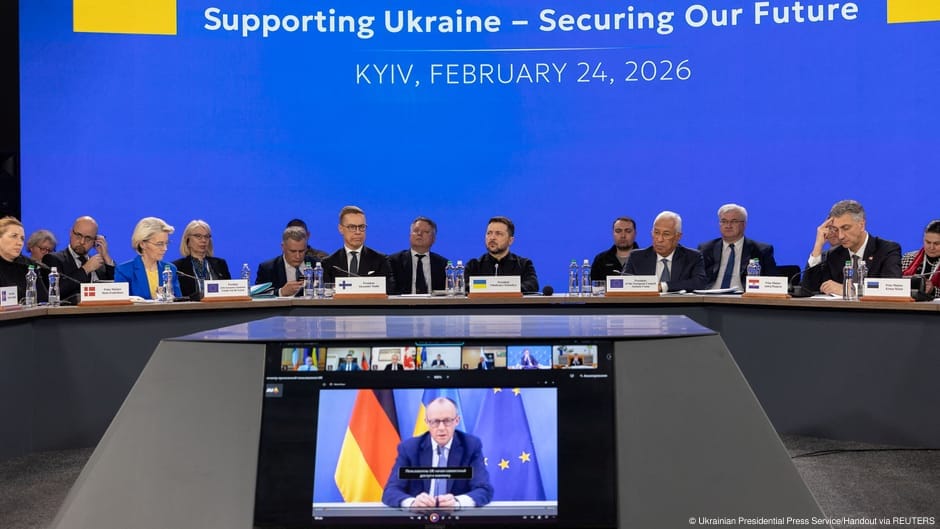
European leaders gathering in Berlin are set to connect the immediate security needs of Ukraine with a longer-term question for the continent: whether Europe can prevent further aggression while sustaining the fiscal commitments required for defense, reconstruction and economic stability.
Ahead of the November 19 meeting of leaders from the “coalition of the willing,” Thomas Röwekamp, chairman of the German Bundestag’s defense committee, said Ukraine must be able to enter negotiations from a position of strength. He rejected pressure on Kyiv to surrender territory while Russia is still achieving at least some of its military objectives.
“A peace that rewards Putin for his war of aggression would not be peace, but an invitation to the next aggression,” Röwekamp said.
His argument frames support for Ukraine not simply as wartime assistance, but as an investment in Europe’s future security architecture. A settlement perceived as rewarding military aggression could increase the risk of renewed conflict, prolong uncertainty for businesses and governments, and force European states to carry higher defense costs over an extended period.
Röwekamp said continued military support and reliable security guarantees were essential to strengthening Ukraine’s negotiating position. Europe, he added, must act confidently and cohesively. For senior policymakers, that emphasis on unity is economically significant: fragmented national responses could raise procurement costs, weaken strategic planning and complicate efforts to reconcile defense spending with other budget priorities.
Large commitments move security policy into fiscal planning
The Berlin discussions will include support for Kyiv’s air defenses. The financial foundation cited for that effort includes NATO commitments to provide €140 billion in military assistance during 2026 and 2027, alongside a €90 billion European Union loan to support Ukraine over the same period.
Those commitments place Ukraine policy firmly within Europe’s medium-term fiscal outlook. Military assistance, financing for Kyiv and broader security guarantees will compete for budgetary space at a time when governments must also manage domestic investment and other public spending. At the same time, effective air defense and credible deterrence can reduce the probability of further destruction, disruption and escalation, limiting larger economic liabilities in the future.
The meeting is being convened in Berlin at the invitation of German Chancellor Friedrich Merz, French President Emmanuel Macron and Prime Minister Andy Burnham. It will be held under the banner “United for Peace in Ukraine and European Security.” Representatives from 37 countries are expected, mainly at the level of heads of state and government, together with leaders of the EU and NATO.
Berlin police have announced unprecedented security measures in the German capital’s government district, reflecting the seniority of the participants. The breadth of attendance also underlines the extent to which the war has become a shared European policy challenge rather than a matter confined to the countries closest to Ukraine.
Negotiations test Europe’s strategic coordination
The coalition format is intended to provide close coordination and partner support for further direct negotiations between Russia and Ukraine, with active participation by the United States and European countries. Following a recent meeting of negotiators in Abu Dhabi, participants in Berlin will coordinate the next steps.
Marie-Agnes Strack-Zimmermann, chair of the European Parliament’s defense committee, welcomed the decision to hold the talks at the German Chancellery. She described the gathering as an important signal to Russia and China that Germany and Europe would not remain passive while others claimed the right to decide the future of European territory.
That message has implications beyond diplomacy. Europe’s ability to shape negotiations will influence expectations about sanctions, energy security, defense industrial capacity and the durability of public financial support for Ukraine. A coordinated position could provide greater policy predictability, while divisions among participating governments could add uncertainty to investment and fiscal planning.
The coalition has operated since spring 2025. Its most recent in-person meeting took place in Paris on July 13, followed by a hybrid meeting on August 24. France, the United Kingdom and Germany serve as co-chairs.
Participants in coalition meetings include European Council President António Costa, European Commission President Ursula von der Leyen, EU foreign policy chief Kaja Kallas and NATO Secretary-General Mark Rutte. Their involvement brings together the institutions responsible for political coordination, financing, foreign policy and collective defense.
For Europe’s decision-makers, the Berlin meeting therefore carries two linked tests. The first is whether the coalition can improve Ukraine’s leverage in direct negotiations through military assistance and credible guarantees. The second is whether European governments can turn substantial short-term commitments into a coherent long-term strategy that contains security risks without allowing the associated economic burden to become fragmented, unpredictable or politically unsustainable.



