Zelensky Says Crimea Bridge Will Not Survive as Economic Risks Mount
Repeated strikes on the strategic crossing threaten Russian military logistics while raising the long-term cost of sustaining control over Crimea.
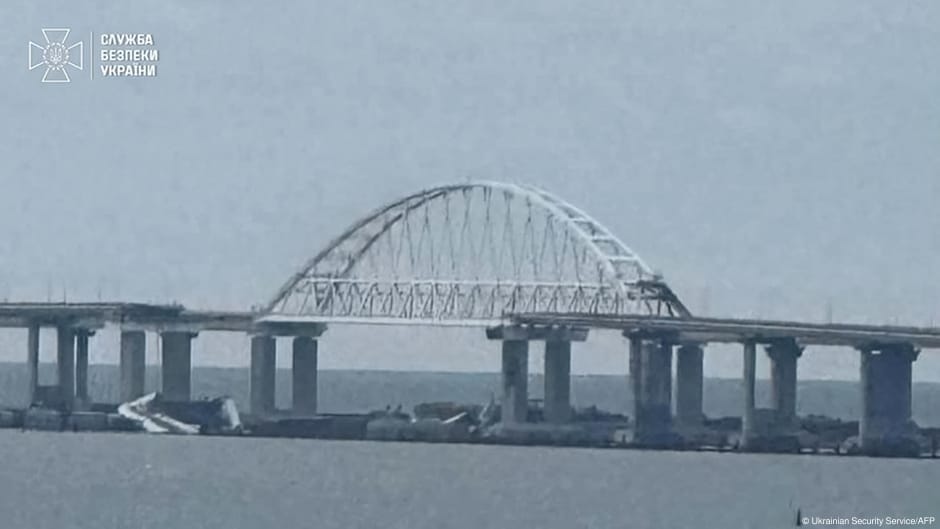
Ukrainian President Volodymyr Zelensky has said the Crimea Bridge will not survive because Kyiv considers the strategic crossing a legitimate military target, signaling that attacks on infrastructure linking Russia to the occupied peninsula could continue. Beyond the immediate military consequences, the bridge’s extensive damage creates a potentially costly reconstruction challenge for Moscow and increases uncertainty around transport, logistics and the long-term economic burden of maintaining Russian control over Crimea.
Speaking in an NBC News interview on Friday evening, November 20, Zelensky said Russian President Vladimir Putin “must understand that this bridge will not survive.” The bridge crosses the Kerch Strait and connects Russia with Crimea, which Moscow annexed after Russian forces occupied the Ukrainian peninsula in spring 2014.
“This is our entirely legitimate target, because they occupied Crimea — our Crimea,” Zelensky said.
The Ukrainian president argued that Russia had first occupied Ukrainian territory and then built the crossing while declaring it part of Russia. He noted that Moscow subsequently changed its constitution and domestic legislation in an attempt to formalize its claims over Ukrainian territories. Those measures, Zelensky said, received no international support or recognition.
Infrastructure damage raises Russia’s fiscal and logistical burden
The bridge has strategic value because Russia continues to use it to move as many weapons as possible to Crimea, according to Zelensky. Daily reports from Ukraine’s armed forces also frequently identify the annexed peninsula as a launch area for missiles and unmanned aerial vehicles. Any lasting reduction in the crossing’s capacity could therefore complicate Russian military supply chains and force Moscow to rely more heavily on alternative routes.
The damage also presents an infrastructure problem whose scale and duration remain unclear. Occupation authorities in Crimea reported a strike on the bridge on the morning of November 16 and restricted traffic. A day later, reports said that one of the bridge’s arches and part of the roadway had collapsed into the sea after a repeat strike. The railway section was targeted during the night of November 19 and is now heavily damaged.
Russian Deputy Prime Minister Marat Khusnullin said on November 20 that Ukrainian strikes had damaged the main beam of the arched span as well as the arch itself. He said possible reconstruction timelines could be determined only after engineering design solutions had been produced.
The uncertainty complicates planning for an asset that supports both civilian connections and military logistics. Russian authorities had announced the resumption of train traffic across the bridge one day earlier. Khusnullin said at the time that officials expected to assess the repair schedule within a week. Some individual elements might be restored within one or two months, he said, while the remaining work would depend on further examination. He also pointed to the current storm season as a constraint on assessment and construction.
Repair estimates expose a potentially prolonged disruption
Andriy Koretsky, an associate professor in the bridges, tunnels and hydraulic structures department at Kyiv’s National Transport University, estimated that reconstruction could take between 18 months and three years. He said production of the arch alone would require about a year, followed by assembly at a work site, transportation and installation.
Koretsky also questioned whether Russia would be able to install another such arch near Ukraine’s border without facing further disruption. His assessment underscores the risk that reconstruction spending may not produce a durable restoration if the bridge remains exposed to additional attacks.
For senior economic and policy decision-makers, the episode illustrates how repeated damage to a single strategic asset can generate consequences beyond the battlefield. A prolonged loss of road or rail capacity can increase transportation costs, create delays and require additional public resources for engineering, security and reconstruction. The source does not provide a repair-cost estimate, but the combination of major structural damage, adverse weather and the possibility of renewed strikes makes the eventual timetable difficult to predict.
The bridge’s vulnerability may also affect Moscow’s broader allocation of resources. Restoring sections of the crossing while protecting them from further attack would compete with other infrastructure and wartime priorities. If repairs take years rather than months, Russia would face a sustained logistical constraint at a time when the bridge remains important for moving equipment to Crimea.
Kyiv links pressure on the bridge to its territorial strategy
Zelensky indicated that Ukrainian attacks could continue, saying Russia should experience the reality of war and recognize that it cannot preserve control over the peninsula indefinitely. He said Russian forces had attacked several Ukrainian facilities, requiring Kyiv to respond, including with a strike against the Crimea Bridge.
Ukraine, he added, would not accept the occupation of its territories, whether the issue is resolved through diplomacy or military action. That position places the bridge within Kyiv’s larger strategy of contesting Russian control over Crimea rather than treating attacks on the crossing as isolated operations.
The resulting economic risk is therefore tied to the unresolved territorial conflict. As long as the bridge serves Russian military logistics and Ukraine regards Crimea as occupied territory, any reconstruction effort may remain vulnerable. The immediate question is how quickly Russia can restore capacity; the longer-term issue is whether a costly fixed link can operate reliably while remaining an acknowledged target in an active war.



