Russian Drone Briefly Enters Polish Airspace During Ukraine Attack
Poland withheld fire to protect civilians, underscoring the economic and security costs of managing spillover risks along NATO’s eastern flank.
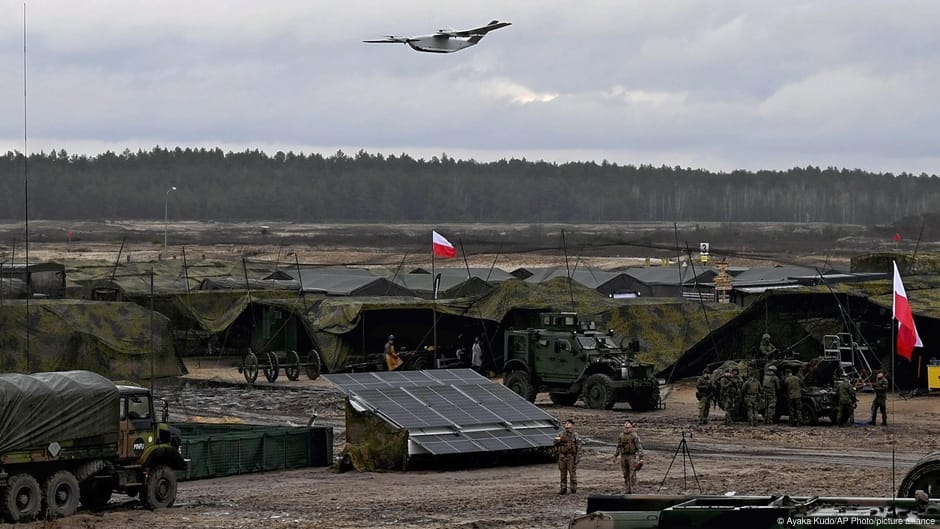
A Russian unmanned aerial vehicle briefly entered Polish airspace during an attack on targets in western Ukraine, Poland’s armed forces said early on Tuesday, November 24. Polish radar systems continuously tracked the drone, and authorization was granted to destroy it, but commanders ultimately refrained from using weapons because of the potential danger to civilians.
The drone later changed course and flew eastward, according to the Polish military’s statement on the social media platform X. The incursion was short, but it added to a sequence of security incidents affecting Poland as Russia continues attacks near the western reaches of Ukraine.
For senior economic and policy decision-makers, the episode illustrates how the consequences of the war extend beyond Ukraine’s borders even when an incident causes no reported physical damage. Each airspace violation can require rapid military mobilization, civil alerts and closer surveillance, while increasing pressure for additional investment in detection, interception and public-warning systems.
Risk management at the NATO frontier
Poland’s operational command faced a decision involving both national security and civilian safety. Although the military had permission to destroy the object, it decided against firing after the drone turned east, citing the risk that an interception and falling debris could pose to people on the ground.
The decision not to engage reflected a calculation that the immediate threat had diminished as the drone headed east, while the potential cost to civilians remained significant.
The incident highlights the complexity of defending populated border regions. An interception may neutralize an airborne threat, but it can also scatter wreckage over homes, roads or other civilian areas. Allowing an object to leave, meanwhile, can raise questions about deterrence and the credibility of air defenses. These trade-offs are likely to shape future operational protocols and procurement decisions, particularly for systems intended to counter relatively small and mobile aerial targets.
Such choices also carry longer-term fiscal implications. More persistent radar coverage, additional reconnaissance capacity and layered air-defense systems require sustained funding rather than one-off emergency spending. For Poland and other countries near Ukraine, the economic burden of the conflict therefore includes not only conventional defense expenditure but also the cost of maintaining readiness against unpredictable cross-border events.
Civil alerts signal wider disruption
Authorities declared an air alert in Poland’s Lublin Voivodeship on the evening of November 23. Residents of border areas in the country’s southeast were asked to take shelter, the dpa news agency reported.
Even when alerts do not lead to casualties or damage, repeated warnings can affect local economic activity. Border communities may face interruptions to transport, work and public services, while businesses must account for the possibility of temporary shutdowns or changes to operating procedures. Over time, elevated perceived risk can also influence insurance assessments, investment decisions and infrastructure planning in regions exposed to military spillover.
The drone incursion follows another incident with direct relevance for NATO’s approach to surveillance. Debris from three Russian Kh-101 missiles fell in Poland on November 20. After that event, NATO announced that it would deploy an Airborne Warning and Control System, or AWACS, reconnaissance aircraft to Poland to strengthen protection of the country’s airspace.
The decision to reposition the aircraft represents a policy shift toward greater monitoring capacity. Enhanced surveillance may reduce uncertainty by giving commanders more time and information to assess airborne objects. It also demonstrates how individual incidents can lead to a broader and potentially durable allocation of alliance assets.
Economic consequences of persistent security pressure
For Europe, the larger macroeconomic issue is the accumulation of security costs across NATO’s eastern flank. A single brief incursion may have a limited direct financial effect, but repeated episodes can accelerate defense commitments, reinforce demand for specialized military technology and redirect public resources toward border protection and emergency preparedness.
Governments must balance these requirements against other budget priorities. Higher security spending can place additional pressure on fiscal planning, especially when surveillance deployments, equipment purchases and civil-defense measures become permanent. The need to protect civilians also means that military investment cannot be considered in isolation; warning networks, shelters, emergency response and local infrastructure form part of the same resilience framework.
The Polish response shows that air-defense policy is not simply a question of whether an object can be intercepted. It is also a calculation involving geography, population density and the secondary risks created by military action. As Russia’s attacks continue near western Ukraine, Poland and NATO are likely to face recurring pressure to refine that balance while supporting economic confidence in exposed border regions.
The drone’s departure to the east brought the immediate episode to an end without Poland firing. Strategically, however, the incident reinforces the likelihood that surveillance, air defense and civilian preparedness will remain prominent—and costly—elements of European economic and security policy.



