Poland Plans Eastern Border No-Fly Zone as NATO Weighs Wider Response
Warsaw’s proposed restrictions signal a policy shift with implications for NATO defense spending, regional trade and investment risk.
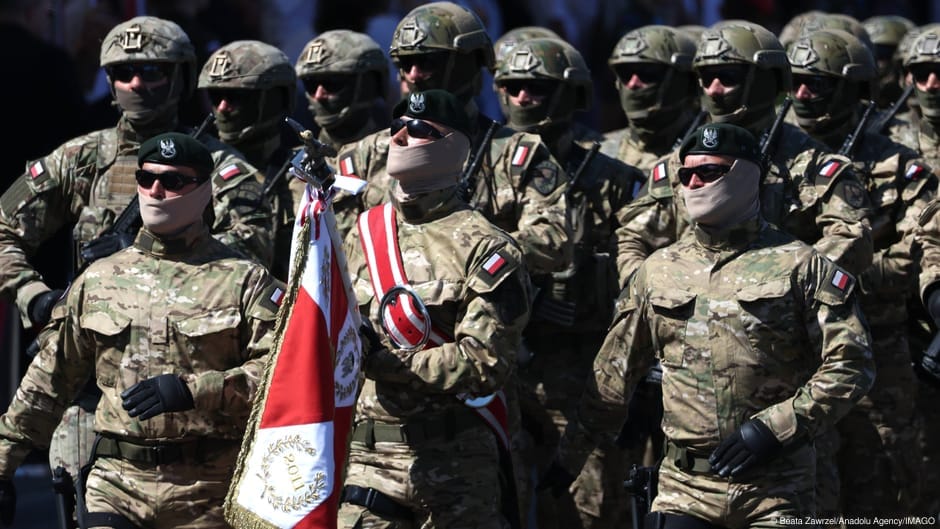
Poland plans to establish a restricted no-fly zone along its eastern border by early 2027, adding another layer to NATO’s defenses as Warsaw seeks faster ways to identify and respond to Russian aircraft entering Polish airspace.
Deputy Defense Minister Cezary Tomczyk said on Wednesday, November 25, that the measure would provide “additional support for the military.” The government is already preparing the necessary decision, and Tomczyk expressed hope that the new restrictions could be introduced “closer to the end of December or in early January.”
“It would be a restricted zone located some distance — from about 12 kilometers to several dozen kilometers — from the border,” Tomczyk said.
The zone would enable Poland’s armed forces to identify Russian aircraft violating national airspace more quickly and, if necessary, shoot them down. Warsaw also intends to urge NATO allies to adopt similar measures along their own eastern borders.
A regional security measure with economic consequences
Although the proposal is primarily military, it also points to a lasting shift in the economic environment facing NATO’s eastern flank. More restrictive airspace management could affect civilian aviation, logistics and economic activity in border regions, while the supporting surveillance and interception capacity may reinforce pressure for sustained defense expenditure.
Some restrictions are already in force in Poland’s border area. Flights are almost entirely prohibited during hours of darkness, while daytime operations are permitted only at altitudes of at least three kilometers. A formal no-fly zone would therefore build on an existing regulatory framework rather than create restrictions from scratch.
For senior decision-makers, the broader significance lies in the prospect that temporary security controls could become a more permanent feature of regional planning. If other NATO members follow Poland’s example, businesses operating across the alliance’s eastern territories may face a more complex combination of airspace rules, compliance requirements and infrastructure priorities. At the same time, demand could increase for radar systems, air-defense equipment, secure communications and related services.
The policy discussion also illustrates how the war in Ukraine is pushing NATO members to consider defensive action beyond their own airspace. Earlier on November 25, Bloomberg reported that Polish authorities had proposed that allies intercept Russian missiles over Ukraine when those missiles were heading toward alliance territory.
The proposal was raised on November 23 at a meeting of NATO member-state ambassadors in Brussels. Tomczyk said it did not receive unequivocal support, acknowledging that such a decision would create “many complications.” Polish Defense Minister Wladyslaw Kosiniak-Kamysz later told RMF24 that discussions were continuing, although he did not yet see sufficient “readiness and determination” among allies to take that step.
NATO caution highlights policy constraints
The lack of consensus underscores the economic and strategic trade-offs confronting the alliance. Intercepting missiles over Ukraine could strengthen protection for NATO territory, but it would also require new operational rules, coordination mechanisms and potentially additional deployments. Those choices would carry budgetary consequences and could alter perceptions of escalation risk across European markets.
Poland advanced the proposal after three Russian Kh-101 missiles fell in the country’s southeast on November 20. Prime Minister Donald Tusk said the same day that Poland appeared to be dealing with a “deliberate provocation.” He argued that the airspace violations demonstrated why Polish authorities should participate in negotiations over peace in Ukraine, which has been resisting the Russian military invasion for nearly five years.
Warsaw’s approach therefore combines immediate border protection with a push for a broader NATO policy response. The no-fly zone is narrower than the proposal to intercept missiles over Ukraine and may consequently be easier to implement nationally. Even so, Poland’s intention to encourage parallel restrictions among allies shows that it views coordinated regional action as the more effective long-term model.
For Europe’s economy, the central issue is not simply the direct cost of one restricted zone. It is the continued integration of security considerations into transport policy, infrastructure investment and public spending. Companies and governments planning for the region will increasingly need to treat air-defense resilience and geopolitical exposure as structural economic variables rather than short-term disruptions.



