European Security Charter Signals Broader Shift in Economic Risk Policy
Nearly 40 European states have endorsed security principles that could reshape fiscal priorities, investment decisions and regional resilience.
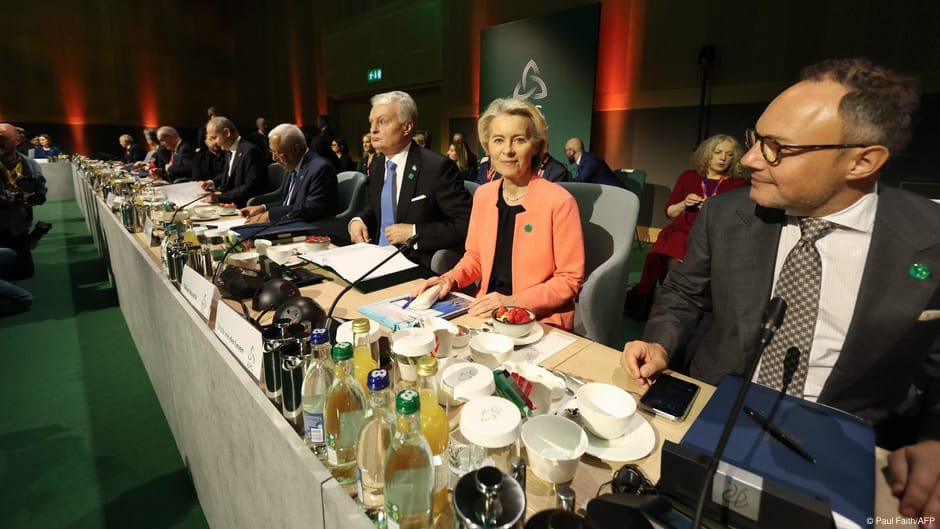
Nearly 40 European countries have agreed on a charter setting out what they describe as the key principles of European security, a move with potentially significant consequences for public spending, investment and cross-border economic policy.
Germany, Ukraine, the United Kingdom, Spain and 35 other European states endorsed the document on Thursday, November 12, during a European Political Community summit in Dublin. France initiated the effort.
The charter consolidates existing foundations of European security while expanding the policy agenda to address newer challenges, including hybrid threats. According to AFP, its signatories condemned Moscow’s intensified hybrid campaigns “in the strongest possible terms” and committed themselves to countering such threats and combating interference in the information environment.
Although framed as a security initiative, the document points toward a wider understanding of economic resilience. Hybrid activity and information interference can affect critical infrastructure, business confidence and the stability of institutions. Governments treating those risks as shared strategic concerns may increasingly incorporate them into decisions on digital systems, energy networks, communications and other essential services.
Europe assumes greater responsibility
The participating states declared that European countries were taking greater responsibility for security on the continent, saying this would have a positive effect on global and transatlantic security. Journalists who reviewed the charter said it draws on the United Nations Charter, the North Atlantic Treaty underpinning NATO and the Treaty on European Union.
“European countries are taking greater responsibility for security in Europe.”
For senior economic decision-makers, that commitment signals the prospect of a durable shift in government priorities. Greater European responsibility may require countries to reconcile security expenditure with already competing fiscal demands. The consequences could extend beyond conventional defence budgets as authorities respond to cyber risks, foreign interference and vulnerabilities affecting supply chains and public infrastructure.
The charter also covers counterterrorism, drug trafficking and the illegal smuggling of migrants. Bringing these issues into a common security framework broadens the range of policies that could influence national budgets and cooperation between European governments. Border administration, policing and institutional coordination all carry economic implications, particularly when threats operate across jurisdictions.
The document’s reliance on established international treaties indicates continuity rather than a departure from Europe’s current institutional order. At the same time, its inclusion of hybrid campaigns reflects a policy shift toward threats that do not fit neatly within traditional distinctions between military security, domestic administration and economic governance.
NATO and the postwar settlement
British Prime Minister Andy Burnham stressed the importance of NATO being mentioned in the charter. He said the alliance would need to “ensure a stable situation” in Europe after the war in Ukraine. A draft of the document states that “any issue concerning European security must be resolved together with Europeans,” according to AFP.
That principle carries implications for the future allocation of political and financial responsibility across the Atlantic. If European governments seek a larger role in shaping the continent’s postwar security architecture, they may also face pressure to provide more of the resources needed to sustain it. The balance between national action, European coordination and NATO commitments will therefore matter for fiscal planning and long-term capital allocation.
A stable postwar framework would also be economically consequential for Ukraine and its European partners. The charter does not specify funding commitments or reconstruction mechanisms, but the debate over security architecture is closely connected to the conditions under which governments and businesses assess long-horizon risks. Durable security arrangements can influence expectations surrounding infrastructure, trade routes and future investment, even when the document establishing broad principles does not itself create economic programmes.
Security architecture enters peace negotiations
Recent peace talks between Russia and Ukraine addressed not only the conditions for establishing a ceasefire but also the architecture of European security. At negotiations in Abu Dhabi, US presidential envoy Jared Kushner supported the creation of a “new” security architecture for Europe.
The European charter places participating countries more visibly within that debate. Its assertion that European security questions should be settled together with Europeans suggests that governments want a direct role in decisions that could define the continent’s political and economic environment after the conflict.
For businesses and policymakers, the immediate importance of the initiative lies less in operational detail than in its strategic direction. The signatories are linking military stability, hybrid resilience, counterterrorism, migration-related crime and information security within a shared framework. If translated into national policies, that broader definition of security could affect regulation, procurement and public investment over many years.
The longer-term economic outcome will depend on how governments implement the principles and distribute their costs. The charter nonetheless signals that European leaders increasingly view security capacity as a foundation for regional stability and for the reliability of the transatlantic system, rather than as a narrowly defined defence matter.



