Bridge Strikes Expose Growing Economic Risks to Ukraine and Crimea
Attacks on strategic crossings in Kyiv and the Kerch Strait threaten transport resilience, urban services and longer-term reconstruction costs.
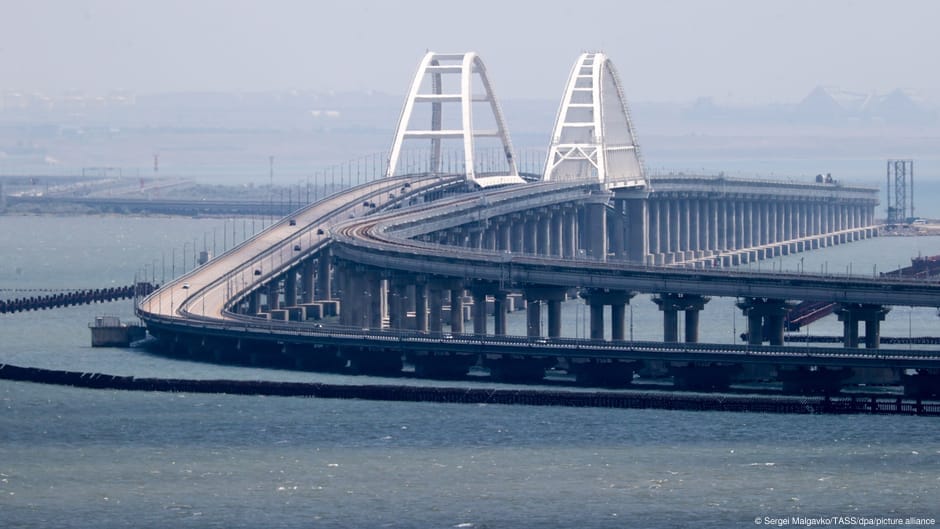
Russian forces struck Ukraine overnight on November 17, with Kyiv among the principal targets and two major crossings over the Dnipro River reportedly hit by ballistic missiles. At the same time, the bridge across the Kerch Strait connecting Russian-annexed Crimea with Russian territory came under renewed attack, underscoring the growing economic and logistical importance of transport infrastructure in the conflict.
Kyiv Mayor Vitali Klitschko preliminarily confirmed strikes on the Northern and Southern bridges across the Dnipro. He also reported interruptions to water and heating supplies in parts of the capital, although he provided no detailed assessment of the damage. Social media users published photographs and videos showing at least one explosion near the Northern Bridge, while local Telegram channels reported utility disruptions in districts on the river’s eastern bank.
Municipal authorities temporarily closed traffic on both bridges. Kyiv’s metro operator said on the morning of November 17 that service had stopped on the section of the green line running across the Southern Bridge. The interruption affects not only passenger movement but also the connectivity of a city whose residential districts, workplaces and public services are distributed across both banks of the Dnipro.
Transport disruption raises wider economic costs
For senior policymakers and business leaders, the immediate significance lies in the cumulative pressure on urban mobility, essential services and supply chains. Even temporary bridge closures can redirect traffic to a smaller number of crossings, lengthen journeys and complicate the movement of workers, goods and emergency services. Disruptions to water and heating add another layer of economic risk as Ukraine enters the colder part of the year.
Russian forces have repeatedly attacked transport crossings in Kyiv since early October 2026. Against that backdrop, city authorities have begun examining alternative ways to maintain connections across the Dnipro. Ukrainian Restoration, Infrastructure and Transport Minister Mykola Kalashnyk previously said the options included pontoon crossings and, over the longer term, construction of a tunnel beneath the river.
The search for pontoon routes and a possible tunnel reflects a shift from repairing individual assets toward building redundancy into critical infrastructure.
That shift carries substantial long-term consequences. Additional crossings may improve resilience, but they also require financing, construction capacity and materials that must compete with housing, energy and industrial reconstruction. Repeated damage can therefore raise the eventual cost of recovery even when individual attacks do not permanently disable an asset. It may also influence future urban planning by making security and network redundancy more prominent considerations in capital investment.
Kerch crossing remains a strategic vulnerability
In the Kerch Strait, Sergei Aksyonov, the Russian-installed head of annexed Crimea, reported an attack on the bridge linking the peninsula with Russia. He said traffic across the Crimean Bridge had been suspended and promised further information, but had issued no additional update several hours after the attack.
The bridge had also been attacked the previous night, with vehicle traffic closed until the evening of November 16. Telegram channels Astra, Mash and Exilenova+ reported that one of the bridge’s arches was damaged. That claim had not been officially confirmed.
The crossing has faced repeated Ukrainian attacks since Russia launched its full-scale invasion of Ukraine. The first such incident occurred in October 2022 and the second in July 2023, with both causing serious damage. In June 2025, the Security Service of Ukraine said it had conducted an underwater operation to demolish the structure’s supports, although no significant consequences from that operation were reported.
Repeated closures of the Kerch crossing can increase uncertainty around passenger and freight movements between Russia and Crimea. Its exposure also illustrates the economic limits of relying heavily on a small number of high-value transport corridors. When a strategic link is interrupted, traffic must wait or shift to alternative routes, potentially increasing transit times, operational costs and pressure on other logistics infrastructure.
Infrastructure resilience becomes a policy priority
The attacks in Kyiv and the Kerch Strait point to a broader macroeconomic challenge: transport networks increasingly function as both strategic assets and recurring fiscal liabilities. Governments must preserve day-to-day mobility while allocating resources for repairs, protection and alternative routes. The resulting demands can strain public budgets and complicate reconstruction planning.
For Ukraine, the pressure is particularly acute because transport investment must proceed alongside the restoration of power, heating, water systems and damaged communities. For Russia and the authorities administering annexed Crimea, repeated disruption of the Kerch crossing creates continuing logistical exposure. In both cases, the economic consequences extend beyond physical damage to include delays, reduced reliability and the cost of maintaining contingency capacity.
The longer such attacks continue, the more likely infrastructure policy is to prioritize dispersed networks, backup crossings and protected routes over efficiency alone. That recalibration could shape public investment and regional logistics long after the immediate disruptions have ended.



