Slovak Protests Expose Economic Risks From Political Polarisation
Mass demonstrations against Robert Fico’s government highlight mounting concerns over institutional stability and Slovakia’s policy direction.
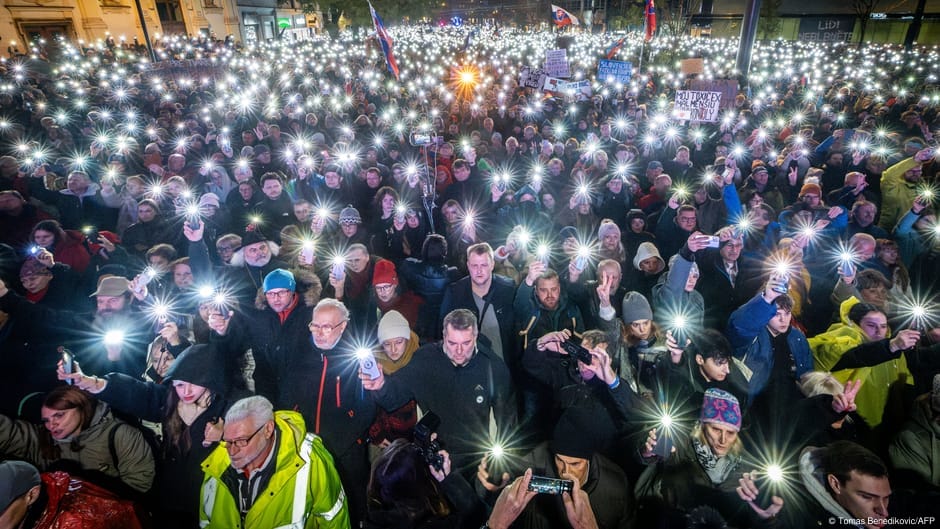
Thousands of people took to the streets across Slovakia to protest against Prime Minister Robert Fico’s government, its ties with the Kremlin, efforts to control the media, alleged violations of LGBT rights and concerns over the rule of law.
The demonstrations were held on Monday, November 17, to mark the 37th anniversary of the beginning of the 1989 Velvet Revolution in Czechoslovakia. That historical connection gave the protests a broader significance: participants linked present-day political disputes to the democratic and institutional transformation that opened Central Europe to market reforms, international investment and deeper economic integration.
The largest gathering took place in Bratislava’s Slovak National Uprising Square. Progressive Slovakia, the country’s largest opposition party and the organiser of the rally, estimated attendance at approximately 25,000 people.
The crowd chanted, “We have had enough of Fico,” while demonstrators carried banners demanding the resignation of the three-party government led by the prime minister. Some placards read, “Russians, go home!” and “I do not want a country that I will have to flee.”
“I do not want a country that I will have to flee,” one protest placard said.
Some participants told AFP that they were dissatisfied with Slovak Foreign Minister Juraj Blanár’s recent visit to Moscow. The objections underscored the extent to which Slovakia’s relations with Russia have become intertwined with domestic arguments over democratic governance and the country’s strategic direction.
Institutional uncertainty becomes an economic variable
For senior economic decision-makers, the scale of the demonstrations matters beyond immediate party politics. Persistent disputes over the rule of law, media independence and the durability of governing coalitions can influence perceptions of policy predictability. Companies making long-term investment decisions typically assess not only tax rates, labour costs and infrastructure, but also the stability of institutions and the consistency of regulation.
The protests therefore point to a potential confidence problem for Slovakia if political polarisation intensifies. The country’s economic trajectory since the Velvet Revolution has been closely associated with institutional convergence and participation in wider European economic structures. Public concern that those foundations are weakening could affect expectations among businesses, workers and investors, even before any measurable change appears in economic data.
The migration message displayed at the rally also carries a long-term economic warning. The placard expressing fear of having to leave Slovakia was political in intent, but it reflects a broader risk relevant to employers and policymakers: prolonged institutional dissatisfaction can encourage skilled workers and younger citizens to consider opportunities abroad. The source article provides no migration figures, but the sentiment itself illustrates how political trust can intersect with labour supply and human-capital retention.
Coalition weakness raises questions over policy continuity
Fico’s governing coalition recently lost its absolute majority in parliament after several lawmakers left its ranks, AFP reported. The opposition has since demanded an early parliamentary election, although it does not have the votes required to approve such a move.
This parliamentary arithmetic leaves Slovakia in a period of heightened uncertainty. A government without an absolute majority may face greater difficulty advancing legislation, maintaining coalition discipline or providing a clear medium-term policy path. For business leaders, the key issue is not simply whether an early election occurs, but whether the current political configuration can deliver stable and credible decisions.
The opposition’s inability to secure sufficient votes for an early election also suggests that the standoff may persist. Continued mobilisation in the streets, combined with legislative fragility, could keep attention focused on political survival rather than longer-term economic priorities. That risk is particularly relevant when governments must respond to external pressures while sustaining investor confidence and social cohesion.
Slovakia’s dispute has wider regional implications
The controversy surrounding the government’s Kremlin connections and Blanár’s Moscow visit also raises questions about Slovakia’s international policy orientation. For global executives and policymakers, foreign-policy signals can shape assessments of political alignment, sanctions-related exposure and the reliability of cross-border economic coordination.
The demonstrations do not by themselves determine a change in government or policy. Nor does the opposition currently possess the parliamentary support necessary to force an early election. They do, however, reveal substantial public resistance to Fico’s course and show that institutional governance, relations with Russia and civil rights have converged into a single political dispute.
The immediate challenge for Slovakia is parliamentary and domestic. The longer-term economic consequence will depend on whether political leaders restore predictability and confidence or allow institutional tensions to become entrenched. For a country whose post-1989 development has been built around democratic transition and international integration, the durability of those foundations is an economic issue as much as a political one.



