Poland’s Independence March Exposes Deepening Political and Economic Divide
The Warsaw rally highlighted institutional tensions and nationalist pressures that could shape Poland’s policy direction and investment climate.
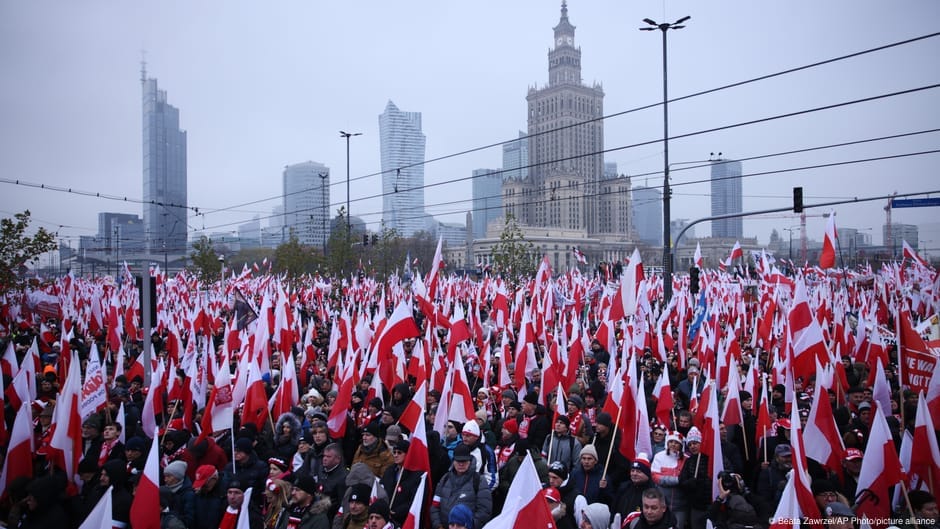
Polish President Karol Nawrocki joined a major Independence Day march in Warsaw organized by nationalist and far-right groups, placing the country’s intensifying political divisions on prominent public display. Warsaw authorities estimated that about 250,000 people participated in the demonstration on Wednesday, November 11, while organizers claimed attendance exceeded half a million.
The scale of the gathering matters beyond domestic politics. Poland is one of Central Europe’s largest economies, and the confrontation between the government of Prime Minister Donald Tusk and Nawrocki’s political camp raises questions about institutional stability, the direction of public policy and the country’s longer-term relationship with European partners. For senior decision-makers, the march offered a visible measure of the nationalist constituency capable of influencing debates over migration, sovereignty and the authority of state institutions.
The demonstration took place only days after a shooting in central Krakow that killed six people. It also unfolded amid a struggle between Tusk’s government and the president’s camp for control of Poland’s Constitutional Tribunal. Authorities introduced reinforced security measures for the event.
Institutional conflict adds to policy uncertainty
The dispute over the Constitutional Tribunal is particularly consequential for Poland’s governance outlook. Prolonged conflict over the body responsible for constitutional review can complicate legislation and weaken predictability at a time when businesses and investors must assess regulatory stability. The president’s decision to attend a march associated with nationalist and far-right organizers also underscored the widening political distance between the two branches of executive leadership.
Nawrocki was photographed carrying the Polish national flag. He called for a “strong and capable state” and criticized “elites acting against the will of the people.” Tusk declined to participate in the demonstration and instead appealed for national unity.
“On November 11, all hearts are white and red,” the prime minister said.
The competing messages reflected a broader contest over the meaning of sovereignty. Nawrocki emphasized state capacity and popular will, while Tusk sought to present Independence Day as a shared national occasion. The outcome of that contest may influence Poland’s future approach to migration, relations with European institutions and the balance between national authority and external commitments.
Before the march began, the Polish national anthem was played. Some participants carried torches whose thick smoke enveloped the procession. Many wore Poland’s red and white colors, and demonstrators waved national flags throughout the event.
Nationalist pressure enters the economic debate
Near the Palace of Culture and Science, tents and stalls formed what journalists described as an “independence city.” Rosaries, prayer books, red-and-white wreaths, hot tea and sauerkraut were distributed there. Antisemitic and anti-Ukrainian books were also available, alongside items displaying far-right symbols.
Some participants carried banners reading “Make Europe white again,” “Poland is not for sale” and “Remigration, deportation.” The first slogan echoed US President Donald Trump’s “Make America Great Again” political branding. Such messages point to political pressure for tighter migration policies and a more protectionist understanding of national sovereignty.
For Poland’s economy, the longer-term significance lies in whether these positions move from demonstrations into policy. Migration policy affects labor supply, while nationalist demands can shape attitudes toward foreign capital, cross-border trade and European cooperation. The march itself did not establish new economic measures, but its size demonstrated the reach of political forces seeking a harder line on migration and national control.
That constituency could become increasingly important as Poland balances domestic political demands with its role in European markets. Institutional disputes may also absorb government attention and make durable policy compromises harder to achieve. For companies operating in the country, the central issue is not the symbolism of a single march but whether polarization produces abrupt shifts in regulation or prolonged uncertainty over the legitimacy of state decisions.
A recurring event gains presidential weight
Right-wing extremists have organized similar demonstrations in Poland every year since 2011. Organizers present the event as a commemoration of Poland’s restoration of independence on November 11, 1918, following 123 years of foreign rule by Russia, Prussia and Austria.
This year’s presidential participation gave the march additional political weight. It linked a recurring nationalist mobilization directly to the office of the head of state while the prime minister remained absent. The contrast reinforces the likelihood that debates over state authority, migration and Poland’s political direction will remain central to the country’s policy environment.
For international investors and policymakers, Poland continues to combine economic importance with mounting institutional and ideological competition. The Warsaw gathering showed that the nationalist right can mobilize on a large scale, while the disagreement between Nawrocki and Tusk illustrated how that pressure intersects with conflict at the highest levels of government. The economic consequences will depend on whether political polarization remains symbolic or translates into sustained changes in law, labor policy and Poland’s engagement with Europe.



