EU Budget Summit Ends Early as Spending and Debt Divisions Persist
Disputes over fiscal restraint, regional support and common borrowing have delayed agreement on the EU’s 2028-2034 budget.
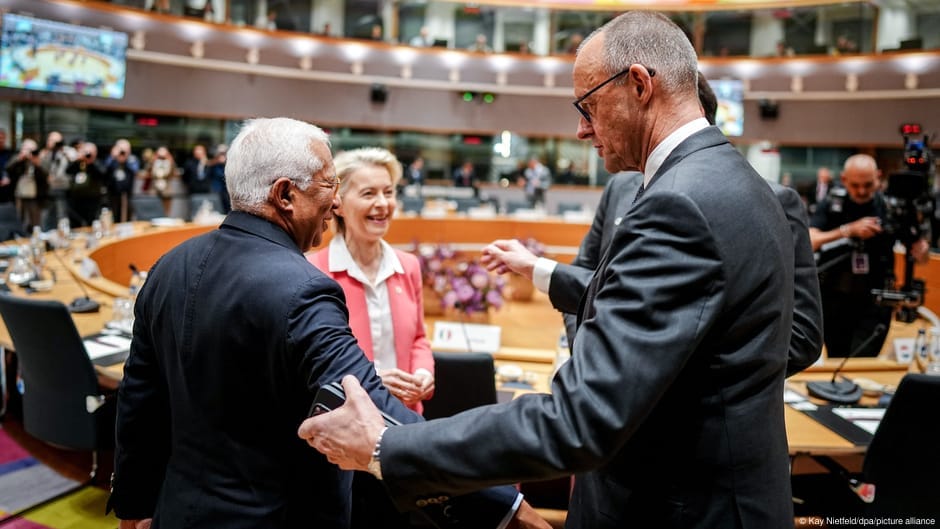
European Union leaders ended a two-day special summit on the bloc’s 2028-2034 budget after only one day, exposing deep divisions over spending, debt and the distribution of costs among member states. Germany and several other net contributors are pressing for further reductions, while France, Italy, Spain and Poland oppose cuts that could weaken regional development and agricultural support.
The meeting opened in Brussels on Thursday, November 26, but leaders abandoned plans to continue negotiations the following morning. Instead, they held a final round of discussions late that evening. German Chancellor Friedrich Merz said it had become clear that the summit would not produce a result, acknowledging that national positions on the seven-year budget remained far apart.
“We understand that we will not reach a result this evening,” Merz said at a press conference.
Merz nevertheless said he had not lost hope that an agreement could be reached before the end of the year. Negotiations are due to resume at the EU summit scheduled for December 17-18, leaving leaders with a narrow window to reconcile competing fiscal and strategic priorities.
Fiscal restraint confronts investment demands
Before the summit, Merz met the leaders of six net contributors that oppose higher EU spending: the Netherlands, Austria, Sweden, Finland, Denmark and Belgium. Their stance reflects concern that a larger long-term budget would place a disproportionate burden on countries that pay more into the EU budget than they receive directly.
Merz also criticized the €1.78 trillion budget proposed on November 21 by European Council President António Costa. The proposal was approximately €204 billion below the amount put forward by the European Commission in the summer of 2025, but the German chancellor argued that expenditure should be reduced further.
Germany’s position also challenges the use of common borrowing to finance EU-level programs. Merz argued against raising funds through additional debt because member states will already have to pay more than €150 billion in interest between 2028 and 2034. In his assessment, a further increase in liabilities could eventually cause the EU to “lose its capacity to act.”
That warning places debt-service costs at the center of the budget debate. For senior policymakers, the dispute is not solely about the overall size of the financial framework. It concerns how much fiscal space the EU can preserve for future crises while meeting current demands for economic convergence, agricultural investment, security and support for Ukraine.
Merz called for a “fair distribution” of expenditure and demanded that budget rebates remain in place, allowing net contributors to recover part of their payments. He said Germany contributes about one-quarter of the entire European budget but directly receives only around 8% of those funds.
Southern and eastern members resist deeper cuts
The leaders of Italy, Spain, France and Poland are among those opposing the position advanced by Germany and other advocates of a smaller budget. They want more funding for economically weaker regions and for agricultural development, arguing that tighter spending could reduce the EU’s ability to narrow regional disparities and support politically sensitive sectors.
Italian Prime Minister Giorgia Meloni said Italy was not prepared to approve a framework under which it would contribute more while receiving less. She warned that reaching a financial agreement could take “light years,” illustrating the scale of the gap between net contributors and governments seeking stronger cohesion and farm spending.
French President Emmanuel Macron described Merz’s proposed additional reductions as a “strategic mistake.” At the same time, he called for an agreement before the end of the year because his participation in the talks will become more difficult in the coming months ahead of France’s presidential election, scheduled for April 18.
The disagreement highlights a broader macroeconomic dilemma. A smaller budget could limit pressure on national contributions and contain shared financial liabilities, but it could also constrain investment in less-developed regions and agriculture. Those programs influence economic convergence, domestic demand and political cohesion across a union whose members have markedly different fiscal capacities.
Ukraine financing adds another layer of pressure
Leaders also discussed further financial assistance for Ukraine, including a proposed additional €45 billion loan for Kyiv in 2027. The issue compounds the challenge of designing a long-term budget because governments must balance support for Ukraine with existing spending commitments and concerns about the EU’s debt burden.
Merz called assistance to Ukraine a task that EU countries must address collectively. He emphasized that the union consists of 27 states, “not 23 or 24,” referring to the fact that the Czech Republic, Slovakia and Hungary are not participating in a €90 billion loan to Ukraine for 2026-2027 that the EU finalized in April.
The early end to the summit leaves the EU without consensus on the scale, financing model or internal distribution of its next seven-year budget. The December negotiations will test whether leaders can combine fiscal discipline with regional investment and geopolitical commitments without deepening divisions between net contributors and states seeking greater support.



