Czech Media Funding Reform Triggers Mass Protest and Fiscal Concerns
A plan to replace household broadcasting fees with state funding has intensified debate over institutional independence and long-term budget pressures.
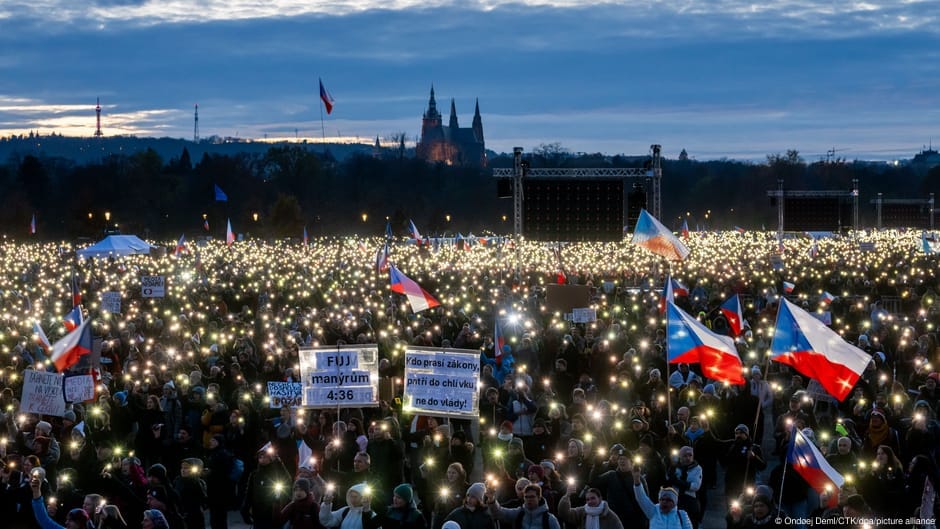
Hundreds of thousands of people demonstrated in Prague on Sunday, November 15, against the Czech government’s plan to overhaul the financing of public-service media, turning a domestic broadcasting dispute into a broader test of institutional governance and fiscal policy. Organizers estimated that approximately 400,000 people attended, potentially making the rally one of the country’s largest protests since the Velvet Revolution.
The government wants to abolish the monthly household fee supporting Czech public radio and television and finance the broadcasters directly from the state budget. Prime Minister Andrej Babiš argues that the reform would fulfill an election promise to reduce the financial burden on citizens. Critics, however, say the change would expose broadcasters to political pressure while delivering a significant real-terms funding cut.
The current household charge is 205 Czech koruna per month, equivalent to about €8.50. Replacing it with budget financing would shift the cost from a dedicated revenue stream to general taxation and annual public spending decisions. Although households would no longer pay the fee directly, the underlying economic cost would not disappear. It would instead be absorbed into a national budget already required to balance competing demands for public services, investment and fiscal restraint.
Budget Shift Raises Governance and Funding Risks
The proposed model would reduce the funds available to public broadcasters by 15 percent. Czech Television’s nominal budget would return to its 2008 level, while Czech Radio’s would fall back to the level recorded in 2005, despite increases in industry costs since those years. Both television and radio organizations have called the proposal unacceptable.
For senior policymakers and investors, the dispute illustrates the long-term consequences of moving an institution from earmarked funding to discretionary budget support. A direct household levy can be politically unpopular, but it offers broadcasters a comparatively predictable source of revenue. Funding through the state budget may provide short-term relief to households, yet it can also subject spending to annual negotiations, fiscal consolidation and changes in government priorities.
The economic implications extend beyond broadcasting. Public media institutions employ journalists, producers, technical specialists and other workers while purchasing services from the wider creative and digital economy. A sustained reduction in their resources could therefore affect employment, domestic content production and investment in broadcasting infrastructure. The nominal return to funding levels from the mid-2000s also suggests a considerably deeper reduction in purchasing power once higher costs are taken into account.
Concerns about institutional independence have been amplified by the legislative process. Activists, civil-society organizations and opposition parties criticized the governing parties for introducing the bill for its first reading outside the planned schedule on Friday, October 23, and arranging a vote for the same night. Such timing is highly unusual in Czech political practice. The Prague demonstration, held at Letná, was consequently named “Letná Against 4:36,” referring to the time scheduled for the vote.
“An elected government has the right to govern the country. But it does not have the right to do whatever it wants and dismantle democratic institutions,” protest organizer Mikuláš Minář said.
Institutional Confidence Becomes an Economic Variable
The governing coalition consists of right-wing and populist parties and is led by Babiš, a billionaire. Coalition representatives, including the anti-migration Freedom and Direct Democracy party, or SPD, have previously criticized media coverage of their activities. Opponents argue that placing broadcasters under direct budgetary control could allow political authorities to influence them through funding decisions.
Activists are demanding that the government withdraw the bill or involve experts who can propose effective guarantees protecting public media from political forces. The opposition has compared the proposed changes with developments in Hungary under Prime Minister Viktor Orbán, where the authorities brought public-service media under their control.
That comparison raises issues with relevance across Europe. Institutional independence, transparent policymaking and predictable regulation contribute to confidence in a country’s economic governance. If businesses or international investors perceive that checks and balances are weakening, the effects can extend beyond the institution directly targeted. Political risk assessments, perceptions of regulatory reliability and confidence in public information may all be affected over time.
The dispute has already disrupted broadcasting operations. Public media organizations staged a strike in early November and restricted their output in protest at the proposed funding arrangement. The action highlighted the immediate operational risks of a reform that combines a new financing mechanism with reduced resources.
For the Czech government, the policy offers a visible household benefit by eliminating a recurring fee. Yet its broader fiscal and institutional trade-offs are substantial. The state would assume responsibility for financing the broadcasters, public media would face a 15 percent reduction in available funds, and future budgets could become a recurring arena for political conflict. The scale of the Prague protest indicates that many Czech citizens view those costs not simply as a media-sector issue, but as a question about the durability of democratic institutions and the credibility of long-term economic governance.



